

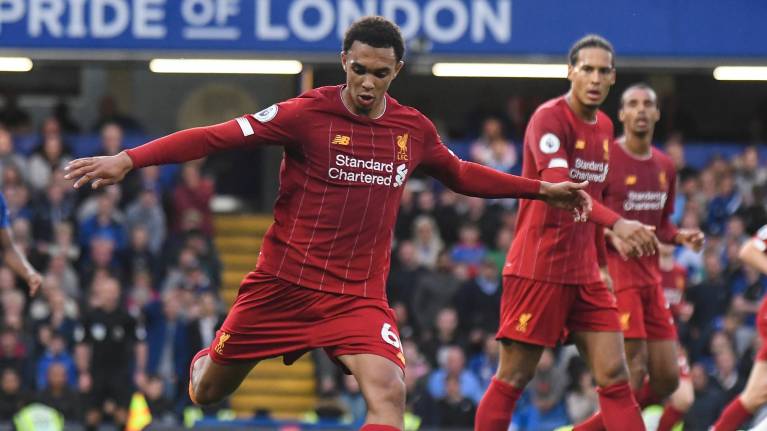
The Premier League, sometimes known internationally as the English Premier League or the EPL, is the top tier of the English men’s football league system. The Premier League is the most-watched sports league on Earth, broadcast around the world and watched annually by billions of fans. The league’s popularity stems from its widely held reputation as the world’s most entertaining football league. With many of the biggest clubs and best players residing there, the division is renowned for its thrilling high-tempo play, competitive matches, and dramatic upsets, not to mention the electric atmospheres that can be found in many of the grounds!
- History
- Premier League Match Format
- Premier League Player Positions
- Premier League Key Rules
- Premier League Season Format
- Famous Premier League Players
- Premier League Terms Glossary
- Attending a Premier League Match
History
The Premier League was established in 1992, when the old First Division broke away from the English Football League to become commercially independent. This allowed it to negotiate its own lucrative broadcasting and sponsorship deals – a highly successful move that brought the peak of English football in line with top European clubs and transformed England’s biggest teams into global entities.
The league held its first season in 1992-93, with 22 football clubs participating. From the 1995-96 season, this was reduced to 20.
For much of its early history, the division was known as the Premiership; the Carling Premiership from 1993-2001, the Barclaycard Premiership from 2001-2004, and the Barclays Premiership from 2004-2007. From 2007-2016, it was known as the Barclays Premier League.
Since its inception, only 7 different teams have won the Premier League: Manchester United, Liverpool, Chelsea, Arsenal, Manchester City, Blackburn Rovers, and 5,000-1 underdogs Leicester City.

Premier League Match Format
The Premier League mainly follows standard football rules, in which 2 teams of 11 players compete to score the most goals over a match.
Premier League Match Duration
Like all football matches, Premier League games last 90 minutes, split into 2 halves of 45 minutes apiece separated by a 15-minute half-time break. Since the clock is not stopped when the ball goes out of play or during a break in play such as an injury or VAR (video assistant referee) review, referees may add time on to the end of each half, which might range from as little as 1 minute to as much as 10. They may add on even longer if necessary, but this would only be in exceptional circumstances such as a very severe injury.
Scoring & Winning a Premier League Match
As in any football match, a goal is scored by putting the ball into the opponent’s net. Or, more accurately, over their goal line – the ball does not need to touch the netting to count. This can happen from open play, via a set-piece such as a corner, or through a direct free-kick or penalty. As a league match, if the teams are tying at the final whistle the match ends in a draw.

Premier League Player Positions
There are 11 players on a football team. While outfield positions have become increasingly fluid in recent years as tactics and player roles have evolved, they can be typically divided into the following categories:
- Goalkeeper – the last line of defence between the ball and the goal, goalkeepers are the only players on the pitch allowed to touch the ball with their hands (inside their own penalty area only); goalkeepers are typically valued for their shot-stopping ability above all else, but some are increasingly valued for their ability to distribute the ball out from the back.
- Defender – players who operate directly in front of the goalkeeper, their primary job is to stop opposition attacks and limit the number of shots their keeper has to face. Depending on their position in the formation, they’re known as either centre-backs, right-backs, or left-backs; right-backs and left-backs are collectively known as full-backs. Most formations use 4 defenders, but some may use 3 or 5.
- Midfielder – players who play in the middle of the pitch, they can play several different roles in the team including protecting the defence, acting as the team’s playmaker, or getting forward to support the attack. Formations typically use 3, 4, or 5 midfielders.
- Forward – players who provide the team’s primary attacking threat; those who play down the middle (known as strikers or centre-forwards) are the players tasked with scoring goals, while wide forwards (more commonly known as wingers, who might also be classed as part of the midfield) are tasked with advancing the ball up the field and crossing it into the penalty area. Depending on the formation, a team will typically have 1, 2, or 3 forwards on the pitch.

Premier League Key Rules
Here are some of the key rules in the Premier League:
- Offside – a player is offside if any part of their body (except their hands or arms) are closer to the opponent’s goal than the second-last opponent (since the goalkeeper will almost always be the last opponent, this is usually the outfield player closest to the goal). An offside offence is committed when a player – who was offside when the ball was played by their team-mate – touches or attempts to touch the ball or interferes with play, such as by obstructing an opponent.
- Handball – except for goalkeepers inside their own penalty area, players are prohibited from deliberately touching the ball with their hands or arms. Goals will also be disallowed even if an attacker accidentally touches it with their arm during the build-up, and defenders may be penalised for touching the ball if they have “made their body unnaturally bigger” such as blocking a shot or cross by leaving their arm outstretched.
- Back-Pass – goalkeepers may not pick up the ball if it has been intentionally passed back to them by a team-mate.
- Foul – an offence that typically results in a free-kick or penalty, such as a reckless or excessive tackle (whether the ball is won or not) tripping or pushing an opponent, or handball.
- Free-Kick – awarded to the opposing team when a player commits an offence while the ball is in play. Free-kicks may be direct, meaning the player taking the kick may use it to shoot directly at goal, or indirect, meaning they must use the kick to pass the ball to a team-mate.
- Penalty – awarded to the opposing team when a player commits an offence in the penalty area, this is used as a direct shot on goal from the penalty spot (12 yards from the goal line); only the taker and the opposition goalkeeper may be in the penalty area when the kick is taken.
- Advantage – when a referee allows play to continue after an offence is committed rather than award a free-kick, because the non-offending team will benefit.
- Goal-Kick – when the ball crosses the touchline at the end of the pitch and was last touched by the opposing team, the defending team restarts play by kicking out from their goal.
- Corner – when the ball crosses the touchline at the end of the pitch and was last touched by the defending team, the opposing team restart play with a kick from nearest corner of the pitch. This is usually used for a direct cross into the box, but the taker may also play the ball short to a team-mate.
- Throw-In – when the ball crosses either of the touchlines along the sidelines of the pitch, a player from whichever team did not touch it last must restart play with a 2-handed overarm throw from where the ball went out of play.
- Yellow Card – also known as a caution, this is a sanction from the referee given to players who have committed a worthy offence (or multiple smaller offences). If a player is shown 2 yellow cards, they will then be shown a red card and sent off.
- Red Card – a sanction from a referee given to players who receive 2 yellow cards or commit a significant offence such as serious foul play or violent conduct. A player who receives a red card is dismissed from the game (known as being “sent off”) and may not be replaced with a substitute. A team forfeits the match if they have more than 4 players sent off, but it is exceptionally rare for more than 2 players to be sent off for 1 team.
- Substitution – when teams swap a player on the pitch with 1 on their bench, either as part of a tactical shift, to give a player a rest, or because the outgoing player has suffered an injury. Premier League teams can make up to 5 substitutions each per match, made on 3 occasions (plus an additional opportunity at half-time).
- Additional Time – also known as added time, injury time, or stoppage time, this is the time added on to the end of each half at the referee’s discretion to compensate for any breaks in play, as the clock does not stop during the game except for half-time.
- VAR – the video assistant referee reviews replays of incidents during the game and advises the referee on the pitch or invites them to review an incident for themselves.

Premier League Season Format
Seasons typically run from August to May. You can find a full breakdown of the calendar in our Premier League Schedule Guide. There are 20 teams in the Premier League and every season they play each other home and away for a total of 38 matches apiece, with 3 points awarded for a win, 1 for a draw, and 0 for a defeat. Teams are ranked on points. Goal difference and then goals scored are used as tiebreakers.
The team that finishes top of the table are crowned Premier League champions, while the bottom 3 are relegated to English football’s 2nd tier, the Championship, and are replaced by 3 promoted teams. European football is also up for grabs based on league position. The top 4 clubs qualify for the UEFA Champions League, while the team that finishes 5th qualifies for the UEFA Europa League, as does the team that finishes 6th if the winners of the FA Cup also finish in the top 5. If the team that wins the League Cup finishes in the top 6, then the 7th-placed team is awarded qualification to the UEFA Europa Conference League.
Famous Premier League Players
The Premier League has been graced by a great many legendary players over the years. Here’s a small selection of some of the biggest names:
- Alan Shearer – the Premier League’s record goalscorer with 260 goals, he fired Blackburn Rovers to their solitary title win before moving to his beloved hometown club, Newcastle United.
- Thierry Henry – scored 175 Premier League goals for Arsenal, winning 2 Premier League titles including the “Invincibles” unbeaten 2003-04 season.
- David Beckham – won 6 Premier League titles, 2 FA Cups, and the UEFA Champions League with Manchester United, and one of the most famous footballers of all time.
- Steven Gerrard – legendary captain of Liverpool, he made over 500 Premier League appearances and won multiple honours including the UEFA Champions League and UEFA Cup, 2 FA Cups, and 3 League Cups.
- John Terry – Chelsea's “captain, leader, legend” won 5 Premier League titles with the Blues as well as the same number of FA Cups, 3 League Cups, and 1 UEFA Champions League and UEFA Europa League title apiece.

Premier League Terms Glossary
- Own Goal – when a defending team mistakenly scores in their own net.
- Set-Piece – a dead ball routine such as corner or free-kick.
- Assist – a pass that leads to a goal being scored.
- Penalty Area – also known as the 18-yard box, this is the area around each goal in which the defending goalkeeper may handle the ball and in which a penalty is awarded if a foul is committed.
- 6-Yard Box – officially known as the “goal area,” this is the smaller box within the penalty area that teams take goal kicks from.
- Possession – the team that currently has the ball is said to be possession; at the end of the game the amount of time each team spent in possession is calculated among other statistics.
- Wall – when defending a direct free-kick, a row of players may line up 10 yards away from the ball to block shots on goal.
- Goal Difference – goals scored minus goals conceded, used as a tiebreaker after points won.
- Diving – also known as simulation, this is the act of attempting to deceive a referee by exaggerating contact or pretending to be fouled with the aim of winning a penalty or free-kick.
- xG – stands for “expected goals,” a statistical metric that measures the quality of a goalscoring chance based on several factors, including the angle and distance of the shot, which determines how likely it is for a player to score in that situation.
Attending a Premier League Match
If you’d like to see a Premier League match live – the best way to experience it – then here are some helpful links: