

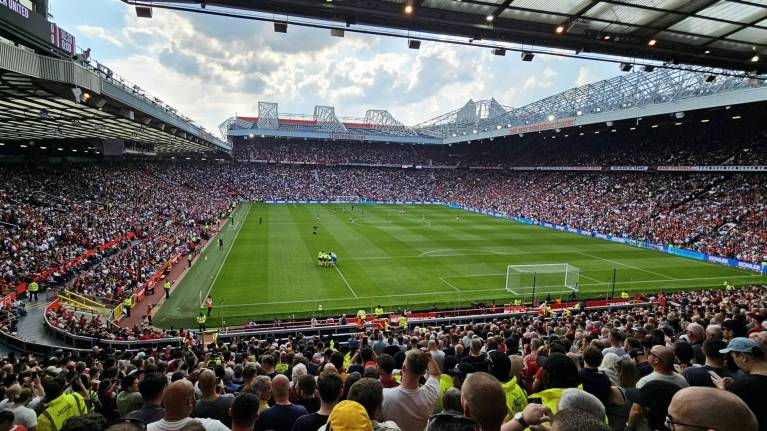
Nothing beats the experience of watching football live. The uncontrollable rush when your team scores, that visceral, primal reaction of thousands of overjoyed fans is felt tenfold compared with watching on TV. Premier League matches – with their famously electric atmosphere, dramatic upsets, and world-class play – are particularly special to attend in person. Visiting your team’s home ground is a memorable moment for any football fan, and there are other small joys, too, from having a more intimate view of the game to socialising with your fellow supporters.
Whether you regularly frequent Premier League matches or are a first-time attendee, this handy guide is here to help you make the most of your matchday experience. If you need help choosing a game and securing tickets, check out our Buying Premier League Tickets Guide here.
- What to Bring and Wear
- When to Arrive
- Venue Parking & Transport
- Entry Gates
- Finding Your Seat
- Match Format and Schedule
- Additional Entertainment
- Crowds and Other Fans
- Taking Photographs and Videos
- Autographs
- Merchandise
- Food and Drink
- Toilets/Restrooms
- Leaving and Exiting the Venue
- Make the Most of It
What to Bring and Wear
Naturally, the most important thing to remember to bring with you is your ticket! Physical tickets are a rarity these days, but if you have them, make sure they’re with you when you leave the house. Most clubs use e-tickets nowadays, though, so make sure your phone is fully charged and the tickets are loading to prevent any issues when you arrive at the stadium.
In terms of what to wear, keep in mind that you’ll be outdoors for an extended period and dress accordingly. Check the forecast ahead of time and wrap up warm if it’s going to be cold, and – while you might be under cover depending on your seat location – it’s always a good idea to bring a coat if it might rain. Likewise, if it’s set to be hot and sunny then bring sun cream with you and potentially a hat or sunglasses too. Koobit’s Destination tabs on each match page display both the current and average weather for the location for the time of year.
Of course, a lot of fans like to represent their team and wear their shirt to the game. If you need to buy your kit ahead of the match, check out the Merchandise section on Koobit’s Premier League page. Unless you’re sat in the away end, don’t wear the visiting team’s shirt or you’ll find yourself ejected from the ground for your own safety.

As for other prohibited items, these will vary from club to club. Many will permit small bags to be brought into the stadium, but the permissible dimensions will vary, so make sure to check the exact size allowed at the ground you’ll be attending ahead of time and allow time for your bag to be searched upon arrival. Some clubs will allow you to bring your own food and water, but these will usually come with restrictions, such as the food must be homemade picnic-style food rather than outside catering, while water may be no more than 500 ml and may either need to be factory sealed or the top might need to be fully removed. Once again, check the club’s website in advance, as some won’t permit any outside food or drinks at all. Many clubs permit bringing flags or banners – provided they’re not deemed offensive in any way – but will have their own restrictions on size.
Other commonly banned items across the league include weapons of any kind, pyrotechnics, flares, and fireworks, air horns, and laser pointers.
When to Arrive
Gates usually open around 90 minutes prior to kick-off. Unless you have pre-match hospitality, there’s little need to arrive earlier than that, and many fans won’t enter the ground right away upon arrival as they’ll be eating and socialising with their fellow supporters outside, buying matchday programmes, or visiting the club shop.
It’s worth bearing in mind that in English football, fans are prohibited from drinking alcohol in sight of the pitch, so if you want a pint before the match, you’ll not only have to queue up for it but also finish drinking it before taking your seat. Getting into the stadium a little earlier can also help you beat the queues for food if you want to eat before the game as well, and the same goes for toilet facilities – which will also be at their cleanest before hundreds of fans make use of them!
If you’d also like to watch the players warm-up ahead of the game, then entering the ground around 30-60 minutes prior to kick-off will give you plenty of time to do everything you need. If you’ve never been to the stadium before, you may want to enter toward the latter end of that time frame to give you plenty of time to find your seats, too.

Venue Parking & Transport
Most stadiums either have fan parking available on-site or several official and unofficial parking options close by for supporters to make use of on matchdays. These are usually pre-bookable, and it’s a good idea to do so where possible to avoid any stress of finding a space on matchdays; if it can’t be pre-booked, be sure to arrive early! Don’t park at any nearby supermarkets, as they will patrol their car parks on matchdays to ensure only customers are making use of them. You can find out more information on pre-booking parking spaces in our Buying Premier League Tickets Guide. If you are arriving or departing by car – whether you’ve driven or utilised a taxi/rideshare service – please note that matchday congestion can make travel very slow, particularly after the match when everyone is departing all at once. There may also be road closures in effect around the stadium or in local neighbourhoods on matchday.
Most stadiums are well-connected in terms of public transport links, so trains, trams, and buses are often a good way of getting to and from the game, although you can expect these services to be busier than usual on matchdays. A lot of grounds are also walkable from city centres, so depending on where you’re coming from, arrival on foot may be a popular method of getting to the match. You can check Koobit’s Travel & Parking tabs for more detailed information for each Premier League ground. On the day itself, be sure to check your route planner for any road closures, strikes, or anything else that might impact your travel so you can change your route or departure time accordingly.

Entry Gates
Most Premier League football grounds have turnstiles running around the perimeter of the stadium, so you’ll rarely be too far from an entrance. You’ll typically have a gate or turnstile assigned on your ticket and you should head to the specified entrance upon arrival at the ground. Although at some stadiums you may be able enter at other turnstiles, this will not always be the case, particularly in grounds that have separate stands rather than a continuous concourse running throughout.
Although there will be stewards and security staff present to conduct bag searches and the like, to enter the venue itself you’ll usually be required to scan a barcode or QR code on your ticket electronically. Queues usually move fairly quickly, but you can bypass them almost entirely by entering the stadium a little earlier.
Finding Your Seat
Seating at Premier League football stadiums will be broken down into stands and sections, and potentially by tier in larger grounds. You can find more information on the different seating areas available in our Buying Premier League Tickets Guide. You won’t be able to mingle with the away fans – or likewise with the home fans if you’re in the away end – but some grounds will give you the run of the concourse all the way around, while others will have separate concourses for each stand. Locating your seat is usually quite straightforward, and stewards will be on hand to direct you. Keep an eye out for section numbers indicated on the walls of the concourse and then the row numbers on the floor as you climb or descend the stairs of the stand; the seat numbers will usually be indicated on the seats themselves.
If you want to watch the players warm up before the game, you should take your seat around 30 minutes prior to kick-off, but some fans may not take their seat until just a few minutes before. Space between seats and legroom will vary between grounds – in some cases you can be quite tightly packed, particularly when fans are coming and going past you! You’re free to leave your seat at any time if you wish to go to the toilet, get a drink, or leave early, but please be courteous to your fellow supporters – try to do so during a break in play or at least when neither team are in the middle of attacking to avoid blocking the view of any key action.

Match Format and Schedule
Football matches are made up of 2 halves of 45 minutes apiece for a total of 90 minutes’ total play time. Referees will add some time on to the end of each half to accommodate any stoppages during the game, such as injuries or substitutions. The advent of VAR (video assistant referee) reviews in recent seasons has led to lengthier periods of stoppage time; whereas before there would rarely be more than 3 or 4 minutes added on at the end of the second half, it’s not uncommon for there to be 5 or 10 minutes added on now.
The halves are separated by a 15-minute period of half-time. Clubs will occasionally put on half-time entertainment, such as fans competing in penalty shoot-outs or crossbar challenges. Prior to kick-off, there may also be pre-match entertainment such as musical performances or a tribute to a guest or former player on the pitch.
Additional Entertainment
Some grounds have fan zones located directly outside. These areas typically feature food or drinks to buy, interactive entertainment, face-painting, and musical performances.
Crowds and Other Fans
Football fans are renowned for being noisier than most other sports crowds, and Premier League matches in particular are known for their passionate atmosphere. Rowdy behaviour in English football has thankfully been largely relegated to the annals of history, and these days going to the match can be a wonderful day out for the whole family. There is a chance you may hear some profanity, but if you’re attending with children, many clubs have dedicated family sections available where the atmosphere will be even more welcoming.
Passionate fans love to chant and sing at Premier League matches, so make sure to brush up on your club’s songs before you go – you'll want to give your best rendition of “You’ll Never Walk Alone” or the “Blaydon Races”! Crowd-wide pitch invasions are rare in the Premier League, so unless your team pulls off a dramatic final-day upset to avoid relegation, you’re unlikely to see one happen – and although it should go without saying, you should otherwise steer well clear of the pitch!
Crowds can get quite tightly packed in the stands and on the concourse. If you need a breather during the game, the concourse will be quite sparse while the action is happening, and likewise you might get a bit more elbow room at half-time when supporters around you head inside for a drink or to use the facilities.

Taking Photographs and Videos
Premier League clubs typically prohibit bringing in professional cameras or recording equipment, but there’s nothing stopping you from taking photos or videos with your mobile phone at any point during the game. However, any recordings you make are only permitted for private and personal use; the Premier League and its broadcasting partners keenly protect their broadcasting rights, so uploading highlights or live streaming to social media is not permitted.
Autographs
If you’re sat very close to the pitch in the first few rows – particularly if your seats are by the tunnel where the players emerge for the game – then you may get lucky and be able to snag an autograph, a selfie, or even a shirt from one of the players when they emerge for the warm-up or after the match. Alternatively, you might also be able to get an autograph when the players first arrive at the stadium or depart on the team bus; you’ll need to make sure you arrive at least an hour before kick-off or wait around for a reasonable length of time after the match to have a chance. Bear in mind that many players will prioritise children, and if you’re going to try to get an autograph or selfie after the game, remember that you’ll be much more likely to get one if the team has won than if they’ve been beaten.
Remember to be polite and respectful, and most importantly, remember to bring a marker pen and something for them to sign!

Merchandise
Premier League clubs will usually have their club shops open on matchdays, so you can buy a shirt, scarf, or hat ahead of the match. However, you might want to purchase your shirt online in advance to wear to the game. By buying online, you may also find better prices. You can find official merchandise on the club’s website or at Fanatics.
Food and Drink
Although the exact food offerings will vary from club to club, you can expect to find all the classics like pies, burgers, and hot dogs almost wherever you go. Some clubs might also have a special item or two, such as Leicester City’s delicious Red Leicester-filled sausage rolls, and you can also expect cold snack items such as crisps or chocolate. Food trucks outside stadiums are also fairly ubiquitous, so it’s easy to eat before you enter the stadium too. If you’re in hospitality, your package will likely include a pre-match meal.
As for drinks, you’ll usually find a range of beers, ciders, and non-alcoholic options. Food and non-alcoholic drinks can be taken to your seat for consumption, but in English football it’s against the law to drink alcohol while in sight of the pitch, so if you buy a pint you’ll need to finish it on the concourse. Queues for concessions will be lengthy immediately prior to the game and during half-time; it’s not uncommon for fans to head inside a few minutes before the end of the first half to get ahead of the queues.

Quality and price will vary from club to club. Per Eloise Feilden of The Drinks Business, according to research carried out by Betting.com in 2024, the cheapest pies in the Premier League range from £3 to £5, while the cheapest pints on offer at each ground ranged between £3 and £6.30. Most clubs will offer pricier fare on top of those options, particularly London-based clubs. Arsenal, for example, also have various pies (Beef Mince & Westcombe Cheddar, Roast Chicken, Sage, & Onion, and Bombay Potato & Pea) for sale at £11, while a Burger, Chips, & Beer food combo will set you back £17.45.
Some clubs, such as Crystal Palace, permit fans to bring their own homemade picnic-style food if they want to save money on concessions, and some also allow a 500 ml bottle of water (which will usually need to be factory sealed, but you’ll be required to remove the top to enter the stadium with it), while others forbid all outside food and beverage.
High-end football grounds such as the Tottenham Hotspur Stadium are cashless, so be sure to have a card with you, but at many you’ll still be able to use cash.

Toilets/Restrooms
Toilets are plentiful in Premier League football grounds, so you’ll not often be far from the facilities. Cleanliness will vary, especially at half-time or full-time once hundreds or thousands of fans have passed through, so it’s recommended to make use of them before the match if possible, which will also help you avoid big queues.
Leaving and Exiting the Venue
With the majority of fans all departing at once when the final blows, leaving the ground can be very busy and a little hectic, although crowds tend to move fairly quickly and the stadium does not take long to empty.
Congestion around the stadium and the influx of fans using public transport after the game can make getting away from the ground a slow process, so allow extra time when planning your journey home. Although many football purists balk at the idea of leaving early – after all, tickets aren’t cheap and you could miss some last-minute drama – some supporters do leave a few minutes before the final whistle, which can make a significant difference to the time you get home.

Make the Most of It
Whether you’re a regular match-goer or it’s a bucket-list experience for you, attending a Premier League game can be a fantastic way to spend your Saturday afternoon, and a little planning ahead can help ensure the day runs smoothly – off the pitch, at least! Minor delays and inconveniences are part and parcel of the live sporting experience, so embrace it and allow for extra time in your plans. Most importantly, win or lose, have a great time!