

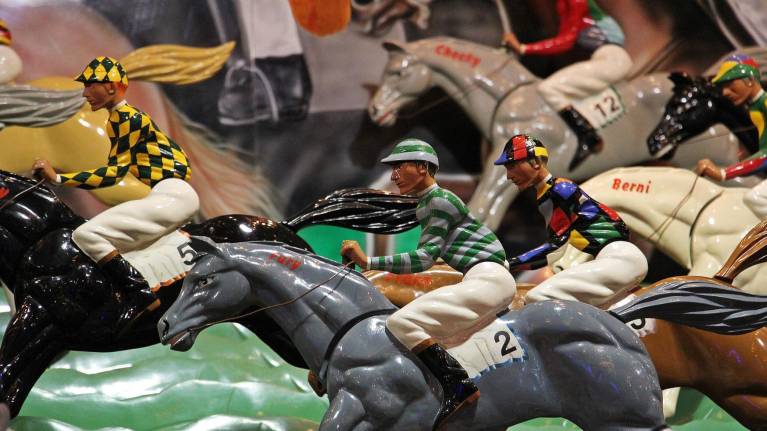
There are 60 racecourses in the UK alone spreading from rural Scotland to the middle of Devon. In the UK, there are 2 types of racing: flat racing and jump racing. Flat racing takes place on a flat track on either turf generally across the summer months (April to October) or all-weather surface. Jump racing is known as National Hunt racing in the UK and Ireland and is run on turf over obstacles known either as steeplechase fences or hurdles usually in the winter months (October to April/May) when the ground is softer.
The “going” is a description of the conditions underfoot on the course and it can affect a horse’s performance. The more moisture in the ground, the softer or slower the going. The drier the ground, the firmer or faster the going. In British racing, going varies from Heavy, Soft, Good to Soft, Good, Good to Firm, and Firm.
Racing is also popular in other countries across the world. In France, it is similar to the UK and Ireland’s system, and in mainland Europe, there are also unique historical races like the White Turf in St. Moritz on a frozen lake and the passionate Palio di Siena in Italy. In the USA, most racing takes place around a circular track either on dirt or turf. This is often the case in the Middle East and Japan. In Australia, racing can happen on circular tracks or longer courses.
A normal race meeting consists of 7 races though can be fewer or more. These races vary in length and in number of runners as well as grading. In National Hunt racing, there are 6 class bands – Grades 1 to 3, Handicap, Listed Handicap, and Conditions – with Grade 1 considered the elite level. The same system applies to flat racing but races are called Group races instead of Graded. At the racecourse, you will be able to get a racecard which shows the horses entered into each race and all the information you need to know about them. Don’t be nervous to ask for a little guidance on what everything means! Take a look at this handy video to learn how to read a racecard:
As well as having a flutter on the horses, there’s so much to do on a raceday! You can dress to impress (though don’t forget to dress for the weather!) with dress codes ranging from the more stringent rules of Royal Ascot to the wellies and brollies of jump racing to the famous Southern Belle hats of the Kentucky Derby. You can enjoy a wealth of activities as well as fantastic food and drink.
Depending on which enclosure you have access to, you can see the horses before the race to help you decide who you’re backing or just to get an idea of the physicality of these great animals. The bell will ring, and the jockeys will mount their horses and take them out to the start line on the course. You can then make your way to the stands and cheer on the runners and riders as they thunder down the track! Once the race is over, the horses will be weighed in to check they are carrying the expected weight, and the winner is crowned: now’s your chance to grab some refreshments before the next race!

Here are some well-known terms to listen out for on your day at the races:
- At the post - when all the horses have arrived at the start line, they are said to be “at the post”
- Blinkers - a form of headgear worn by the horse, consisting of a hood with cups around the eyes to reduce distractions aid concentration
- Colt - an ungelded male horse below 5 years of age
- Classic - group of historic major races for 3-year-olds in the flat season. In Britain, the 5 Classics are the 2,000 Guineas, the 1,000 Guineas, the Oaks, the Derby, and the St Leger – most European countries have their own versions
- Draw - a horse’s starting position in the stalls randomly allotted in flat racing
- Dead-heat - a tie between 2 or more horses for first place, or for one of the other finishing positions. When a winning bet has been made, half the stake is applied to the selection at full odds and the other half is lost
- Each-way - a bet where half the total stake is for a horse to win and half is for a horse to "place" (usually in the first 3, but in big handicaps it may be 4 or 5). If the horse wins, the win portion is calculated as normal, while the place portion of the bet is settled at a proportionate fraction of the odds
- Foal - a horse from its birth to 1 January of the following year (when it becomes a yearling)
- Form - a horse’s race record, which will be listed in a racecard
- Front-runner - a horse whose running style is to lead from the start of the race and stay there as long as possible
- Filly - a female horse aged 4-years-old or younger
- Juvenile/juvenile hurdler - a juvenile is a 2-year-old horse in flat racing. Every horse officially turns 2 on New Year's Day. A juvenile hurdler is the youngest category of hurdler (those that turn 4 during the season in which they start hurdling)
- Maiden - a horse that has yet to win a race, and there are maiden races that are restricted to such horses
- Novice - a horse in the early stages of its career after it has won its first race
- Pacemaker - a horse that is entered in a race to set the pace for another horse with the same owner
- Pulled up - a horse that drops out of a race and does not finish
- Sprinter - a horse that specialises in running over short distances (5-6 furlongs) on the flat
- Stayer - a horse that specialises in racing over longer distances (2 miles or more) on the flat
- Turned out - racecourses often have a “best turned out” award for the horse judged to have been best presented by their groom in the paddock before the race
- Under starter’s orders/under orders - the moment a race is about to begin when the horses are in the stalls (flat racing) or have lined up at the start (jumps racing), they are said to be “under starter’s orders”
Horse racing is accessible to everyone, so whether you're going as a family, a couple, a group of friends, with workmates, or even on your own, you will be sure to have a fantastic day. Take a look at horse racing events here!