

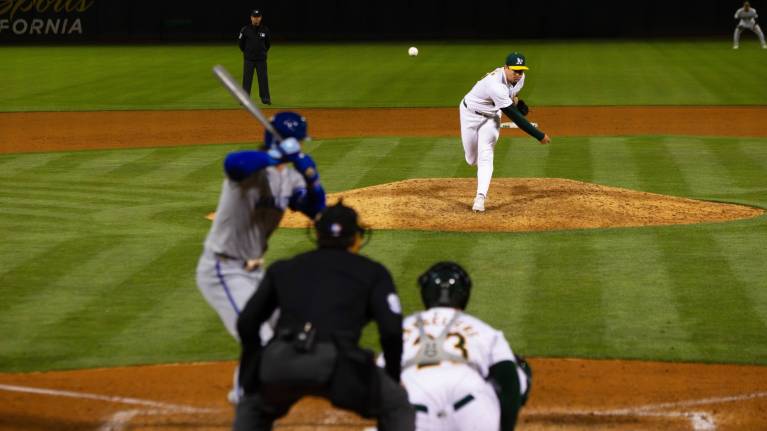
Major League Baseball, more commonly known as MLB, is a professional baseball league based in the United States and Canada. The league is the highest level of the professional game in North America and the most famous baseball league in the world.
As the oldest of all North America’s Major Leagues, tradition and history are part of what make MLB special. Stadiums like Fenway Park in Boston have been in operation since the early 1900s, and former stars like Babe Ruth, Joe DiMaggio, and Jackie Robinson have gone on to become iconic figures in American cultural history.
Today, at MLB ballparks from Philadelphia to Phoenix, the best players in the world continue to employ a combination of speed, power, and athleticism that has captivated generations of North Americans each summer for over a century. With its trademark blend of nostalgia and modern innovation, MLB is baseball at its best.
- MLB History
- MLB Game Format
- MLB Player Positions
- MLB Key Rules
- MLB Season Format
- Famous MLB Players
- MLB Terms Glossary
- Attending an MLB Game
MLB History
MLB was founded in 1903 when the USA’s top 2 professional baseball leagues – the National League (NL) and the American League (AL) – merged into a single organization. The merger followed years of competition between the 2 leagues and resulted in the creation of the World Series – a showcase at the end of each season to determine a national champion. The inaugural 1903 World Series saw Boston, from the AL, defeat Pittsburgh, from the NL. The "Fall Classic", as it is sometimes known, remains the pinnacle of professional baseball today.
MLB’s early years were defined by low-scoring games dominated by pitchers. The Deadball Era (1900–1920), as it is now known, was largely a result of the way baseballs were manufactured and the fact that they were often overused, leading them to become soft, damaged, and hard to hit. Arguably the most famous event during this period was the Black Sox Scandal, in which “Shoeless” Joe Jackson (immortalized in the movie Field of Dreams) and 7 other players were accused of fixing the World Series.
In the 1920s and 30s, MLB’s popularity soared, thanks in large part to the elimination of scuffed or dirty baseballs, and the rise to prominence of stars like Babe Ruth. The league and its teams worked hard to mitigate the impact of the Great Depression throughout the 1930s, which saw innovations like radio broadcasts and gameday promotions introduced.

By the 1940s, baseball was so integral to American culture that President Roosevelt declared that MLB could continue operating despite the USA’s entry into the Second World War. While the careers of stars like Joe DiMaggio and Ted Williams were temporarily halted, MLB persevered with rosters of men exempt from duty (such as one-armed outfielder Pete Gray), helping to increase the morale of those on the home front.
Despite its success, MLB still had major issues, and until the late 1940s, the league had been open to white players only, with black stars forced to play in the Negro Leagues. This finally changed on 15 April 1947 when talented infielder Jackie Robinson made his debut for the Brooklyn Dodgers, breaking baseball’s “color barrier” and opening the doors to black players across the league. Robinson would go on to become one of the best players in MLB history and is celebrated by all MLB teams on 15 April each year.
Between the 1950s–70s, MLB began to expand with 4 teams added in 1961–62, 4 added in 1969, and 2 more added in 1977. More rules were introduced during this period in an attempt to create more hits and runs, including the Designated Hitter initiative, which allows teams to field a specialist hitter, who does not field, but bats instead of the pitcher. Climate concerns and economic issues also led to the creation of more multi-use stadiums in the 60s and 70s, resulting in the first baseball fields with artificial turf. As they were designed to house American football as well as baseball, multi-use stadiums were often bigger than traditional ballparks, which led to more focus on speed and baserunning as home run hitting became more difficult.

After home run hitting in MLB declined significantly in the 1980s, big-hitting came back with a vengeance in the 1990s, but it soon became apparent that many players were using performance-enhancing drugs. Legendary players like Barry Bonds have been denied a place in the Baseball Hall of Fame due to their involvement. The 90s also saw the introduction of MLB’s most recent expansion teams – the Colorado Rockies and Miami Marlins in 1993, and the Arizona Diamondbacks and Tampa Bay Rays in 1998 – taking the league’s total to 30.
Since the early 2000s, MLB’s most modern years have been defined by an increase in analytics and a more statistical approach to the game, as illustrated in the film Moneyball. MLB has also made efforts to improve fan experience, and in 2023, the league introduced a pitch clock to help speed up slow games. On the field, Shohei Ohtani – an MVP caliber hitter and pitcher – heads up a deep list of future hall-of-famers, with the Japanese Superstar drawing comparisons to the legendary Babe Ruth. Finally, in a league that has always balanced tradition with progress, MLB fans can still take a glove along to games, crack open a box of Cracker Jack, and sing along to "Take Me Out to the Ballgame" as their heroes swing for the fences.
MLB Game Format
All MLB games are played under standard baseball rules with the ultimate objective being to score more runs than the opposing team.
MLB Game Duration
There is no clock in MLB and, instead, games last 9 innings. Each inning is divided in half, creating a “top” of the inning and a “bottom” of the inning, hence phrases like “bottom of the 9th”. Teams on the road always bat in the top half of the inning, while the home team always bats in the bottom half. A half-inning is only over when 3 of the batting team's hitters have been determined "out". The batting team can continue to bat until this point. A game of baseball ends when the team that is trailing has received their last 3 outs in the 9th inning. The average MLB game lasts around 2 hours and 35 minutes, but can be longer.
Scoring & Winning an MLB Game
The majority of the action during a baseball game takes place on a diamond-shaped playing area called the infield. At each corner of the diamond is a "base", and in the middle of the diamond is the pitcher's mound. From here, the pitcher throws the ball towards a batter, who stands opposite them on a corner of the diamond called "home plate". At its core, the game revolves around this duel between batter and pitcher.
Scoring in a baseball game is all about runs. The team with the most runs at the end of a game wins. The batting team scores runs by hitting the ball away from the opposition fielders and running around the bases. A full trip around the bases and back to home plate is worth one run. The most efficient way to do this is by hitting the ball beyond the outfield and into the stands, making it impossible for the opposition to retrieve it, and meaning the batter can easily round the bases and score. This is known as a "home run". Hits that stay within the field of play can also lead to runs, but players may have to make slower journeys around the diamond, stopping at bases on the way.

The best way for a defending team to prevent the batting team from scoring runs is by getting batters "out". Three ways to get a batter out include "strikeout" (making a batter swing and miss at 3 good pitches), catching a ball hit in the air before it bounces, and throwing the ball to a base before a batter can reach it.
If teams are tied after 9 innings, MLB games go to extra innings, which is played an inning at a time until there is a winner. In extra innings, the batting team starts with a player already on second base to encourage scoring.
MLB Player Positions
All players, apart from pitchers, bat during a baseball game. The names of positions are generally a reference to the player’s fielding position.
Pitchers
- Starting Pitcher (SP) · A pitcher that starts the game – usually one of the team’s best pitchers, with enough stamina to last multiple innings.
- Reliever (RP) · A pitcher that comes in to relieve the starter, usually in the mid to late innings.
- Closer (CL) · A specialist relief pitcher, skilled in getting the final outs of the game. A closer is often the team’s best reliever, and is most commonly introduced in the final inning.
Batters/Fielders
- Catcher (C) · Catches pitches behind home plate and helps pitcher with strategy.
- First Base (1B) · Fields near first base; usually a power hitter.
- Second Base (2B) · Fields near second base; usually quick and agile.
- Third Base (3B) · Fields near third base; requires a strong arm for throwing to first base.
- Shortstop (SS) · Fields between second and third base; often the best fielder and a supreme athlete.
- Left Field (LF) · Fields in the left portion of the outfield; generally a decent fielder with a good bat.
- Center Field (CF) · Fields in the center of the outfield; must be fast, agile, and an excellent fielder capable of covering a lot of ground.
- Right Field (RF) · Fields in the right portion of the outfield; requires a strong arm and a good bat.
- Designated Hitter (DH) · Doesn’t field so must be a very strong batter.

MLB Key Rules
The following are phrases related to key rules in MLB:
- Strike · When a batter swings and misses at a pitch, or lets the baseball pass through the strike zone. A hitter’s first two strikes can also be incurred on foul balls.
- Strike Zone · The area above home plate between a batter’s shoulders and belt. A pitcher that throws the ball through this area earns a strike.
- Ball · A pitch outside the strike zone that is not hit by the batter. A hitter that receives four balls during their at-bat can automatically walk to first base.
- Strikeout · When a pitcher achieves 3 strikes on a hitter, thus getting them out.
- Foul Ball · A ball batted into foul territory, which lies outside the yellow foul poles and is demarcated by the two perpendicular white lines that run from home base through to the outfield.
- Pitch Timer/Clock · A clock that ticks down while a pitcher is preparing to pitch. Pitchers have 15 seconds to make each pitch when there are no runners on base, and 18 seconds with at least one runner on base. If a pitch is made outside this time, the batter receives a ‘ball’.
- Two-Way Player · A rare player who can both pitch and hit. To officially qualify as a two-way player in MLB, the player must have, in the season prior, pitched at least 20 innings and played at least 20 games as a position player or designated hitter, with at least 3 plate appearances in each game.

MLB Season Format
There are 30 teams in MLB, split across 2 leagues: the National League and American League. Within these leagues, teams are also split across 3 divisions of 5 teams each: AL/NL East, AL/NL West, AL/NL Central.
Regular Season
MLB teams play 162 games each during the regular season. The majority of these games take place against teams in the same division, as well as those in other divisions within the same league, but all MLB teams play each other at least once. Within their divisions, teams are ranked by win percentage, for example, a team with a 90-72 win/loss record would have a .556 win percentage. Winners of each MLB division, both in the AL and NL, qualify for the postseason, alongside 3 “best-of-the-rest” teams from each league.
Postseason
There are 4 stages in the postseason: Wild Card Round, Division Series, Championship Series, and World Series. The 2 division winners with the best records in each league earn an automatic bye to the Division Series.
The MLB postseason is a bracket-style elimination tournament, where the winner of each series advances and the loser is eliminated. The Championship Series determines the champion for each league, and the American League Champion then faces off against the National League Champion in a 7-game season finale called the World Series. The World Series is MLB's ultimate prize and the winners not only take home the Commissioner’s Trophy, but earn the right to call themselves the best team in MLB.
For a full rundown of how the season works and the teams involved, check out our MLB Schedule Guide.

Famous MLB Players
These stars are among MLB’s top current players:
- Shohei Ohtani (Los Angeles Dodgers) · Japanese two-way superstar, with All-Star ability as a pitcher and hitter
- Aaron Judge (New York Yankees) · First Yankees captain since 2014 and one of the most powerful players in the game
- Mike Trout (Los Angeles Angels) · 3-time MVP and future Hall-of-famer
- Bryce Harper (Philadelphia Phillies) · Charismatic clutch hitter and Phillies’ face of the franchise
MLB Terms Glossary
The following are key terms you are likely to see or hear during an MLB game:
- Single/Double/Triple · A hit resulting in the hitter making it to first base (single), second base (double), or third base (triple).
- Home Run · A hit that allows the batter to round all the bases and score a run. Usually, this occurs when a player hits a fair ball over the outfield fence, but can also be achieved “inside-the-park” if a player puts a ball in play and is able to round the bases before the fielding team can tag him out.
- Grand Slam · A home run when the bases are loaded (all occupied by players from the batting team) resulting in 4 runs – one run for the batter, and one each for the players on first, second, and third.
- Double Play · When the defending team is able to get two players out in the same play. For example, a common double play might see the second baseman field the ball, tag out an advancing runner at second, then throw to first, where the first baseman can step on the base to get the hitter out.
- Walk-Off · When a home team takes the lead in the bottom of the 9th inning, thus winning the game. In this situation, the game ends immediately because the opposing team has no batters left to hit, meaning the teams can just “walk off” the field.
- Stolen Base · When a baserunner advances to the next base while the pitcher is throwing, or holding, the ball.
- K · Short term for a strikeout.
- Sacrifice Fly · A hit to the outfield that results in the batter being caught out, but that allows a baserunner to make it home and score a run. The term is drawn from the fact that the batter is sacrificing his at-bat to enable a teammate to score.
Attending an MLB Game
If you’re interested in attending an MLB game, check out the following links: