

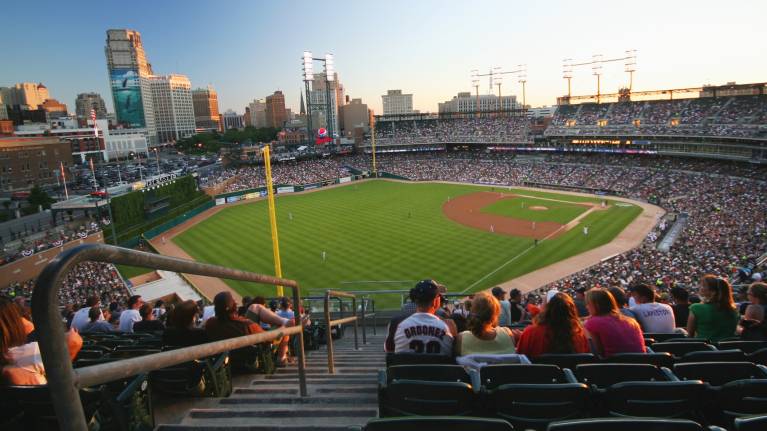
Blue skies, the crack of the bat, and the roar of the crowd - MLB games provide fans with everything they love about baseball on a major scale, while still maintaining the sport’s trademark air of nostalgia and family-friendly atmosphere. Summer trips to the ballpark are a North American tradition and more than 70 million fans visit MLB stadiums each year. Whether you’re heading to sunny Petco Park or historic Wrigley Field, this guide is designed to help both new and existing fans maximize their MLB experience. And if you’re yet to secure seats for an MLB game, remember to visit Koobit’s Buying MLB Tickets Guide for a closer look at the ticket buying process.
- What to Bring and Wear
- When to Arrive
- Venue Parking and Transport
- Entry Gates
- Finding Your Seat
- MLB Format and Schedule
- Crowds and Other Fans
- Taking Photographs and Videos
- Autographs
- Merchandise
- Food and Drink
- Toilets/Restrooms
- Leaving and Exiting the Venue
- Make the Most of It
What to Bring and Wear
As with all sporting events, the most important thing to bring to an MLB game is your ticket. Most MLB tickets are provided electronically these days, either by email, or more often than not, through the MLB or ticket seller’s mobile app. If you are in possession of an e-ticket that needs to be scanned, remember to charge your phone before your visit to the ballpark as you will need it to enter. On rare occasions, you may need to print a physical copy of your ticket, so it’s best to check this information with the ticket supplier before you leave home.
There is no strict dress code for MLB games, but clothing must not be “obscene, indecent, or offensive” and footwear must be worn at all times. Most fans with standard tickets dress in a casual, comfortable manner. Club or hospitality areas don’t usually have a dress code, but it may be worth checking with the venue beforehand. Many fans will choose to wear team jerseys, caps, or t-shirts to a game, so if you want to show your support, check out the MLB Merchandise section on Koobit. Fans are free to openly support the home or away team, but be aware that away team merchandise may, on some occasions, invite some friendly banter from home fans, especially in seating areas like the Bleachers.
Most of the time, what you wear to a baseball game will be dictated by the weather. The MLB season runs from late March – November, so you may opt for t-shirts and sunscreen in the sunny summer months, whereas coats and warm clothing may be required for the beginning and end of the season, which can sometimes be cold and wet. Geography will play a major role, so before you head to a game, check the weather for your chosen venue and dress accordingly – for example, snow is not uncommon for Chicago early in the season, while summers in Kansas City can be extremely hot. To help, Koobit lists current and average weather information on its event pages.

Additionally, it’s also worth doing some research on the ballpark you’ll be visiting. MLB venues are either open, domed, or have a retractable roof. Seven MLB ballparks now boast retractable roofs, meaning fans can enjoy the feeling of being outside on fair weather days, while staying protected from rain, snow, and excessive heat when required. Tampa’s Tropicana Dome is the league’s only permanent dome, meaning all games are played inside. Some newer stadiums, like Globe Life Field in Texas, also have air-conditioning, so even if it’s hot outside, it’s sometimes worth bringing a thin extra layer just in case.
When it comes to what you can take inside in an MLB stadium, most regular bags are prohibited. In general, the only bags you can take inside the venue are clutch bags/fanny packs no larger than 5" x 7", clear/vinyl bags no larger than 12" x 6" x 12", medical bags, and diaper bags. There is a long list of prohibited items at MLB ballparks, most of which are common across all sports venues, including alcoholic beverages, aerosols, pyrotechnics, weapons, laser pens, and more. Please check your chosen venue’s website for full information on bag sizes and prohibited items.
Most MLB venues do permit fans to bring in a sealed bottle of water and outside food (either held in your hand or in a clear plastic bag) in individual portions. For fans on a budget, it’s worth taking advantage of these perks because, although many people view grabbing a beer and a hot dog as part of the experience, food and drink inside MLB ballparks can be expensive.
One unique item you’ll see many fans bring to MLB ballparks are baseball gloves or mitts. Popular with children (and some adults too!) feel free to bring your glove to a game and boost your chances of catching a foul ball or home run.
When to Arrive
More often than not, entry gates at MLB games open 1.5 – 2 hours before the first pitch.
For fans who want to see the pre-game pageantry, including a performance of the national anthem, it is recommended you arrive at least 30 minutes before the game begins.
If you want to wander the concourse and check out some of the ballpark concessions, as well as any exhibitions, museums, or historic quirks a venue might have, it’s best to arrive at least 1 hour/1.5 hours before game time so you can explore these fully.
Finally, ahead of some games, a batting practice session will take place soon after gates open. Many balls end up in the outfield seats at batting practice, so this will be one of your best chances to catch, or find, a unique baseball souvenir. If you want to be part of batting practice, arrive when gates open and head straight for the outfield. Please note, batting practice will not be open to the public before every game, so it is best to check the home team’s website or social media for more information ahead of your visit.
Venue Parking and Transport
Many MLB venues have parking options onsite. Alternatively, as all teams are located in major North American cities, it should not be difficult to find public parking facilities within walking distance of the venue. To ensure you can find a parking space on gameday, it’s best to plan in advance and book early. For official venue parking, visit the home team’s website, and for public parking facilities, try helpful sites like Spot Hero. See Koobit’s Buying MLB Tickets Guide for more on this subject.
If you plan on driving on gameday, it’s recommended that you leave plenty of time to get to the venue to avoid traffic congestion associated with major cities and sporting events. Most venue car parks open at least 2 hours before first pitch. It is also best to double check your route before you begin your journey so as to avoid any recent road closures or traffic events.
One of the best ways to ensure you have a smooth journey on gameday is to take public transport. This can be easier in some locations than in others – for instance, Globe Life Field in Arlington has very little public transport nearby, whereas venues in cities like New York and Chicago are very well served by buses, trains, and subway systems. Even if you are taking the car, parking on the outskirts of a city and using public transport for the last leg of your journey can make for a more relaxed trip and speed up your travel time, especially after the game when parking lots can be very busy.
For more information on traveling to an MLB game, visit the relevant stadium’s Travel & Parking section on Koobit.

Entry Gates
MLB ballparks can be vast arenas, with some holding more than 50,000 fans. Consequently, multiple gates or entrances will be in operation at all venues.
Most tickets will list your gate of entry, but it is not uncommon for stadiums to let ticket holders enter through any regular (non-club) entrance. If you are unsure, you can check this with a member of staff on the gate.
MLB tickets contain scannable codes, and staff members or automated ticket readers will scan your code to validate your ticket and grant you entry to the venue. Security checks take place at all ballparks and may involve airport-style metal detectors and bag searches.
Generally, it should not take long to enter at an MLB stadium, but for popular games, like Opening Day or contests against rival teams, you can expect a short wait. Gates can also become busy a few minutes before the game starts, so it’s always best to arrive in plenty of time to avoid long lines.

Finding Your Seat
The joy of ballparks is that they can vary so greatly, and this is true of venues in MLB. While no 2 MLB stadiums are the same, in general, they boast 3 or 4 tiers of seating, with most seats found in a “U” shape that curves behind home plate and runs down both foul lines. At the top of the “U” is the outfield, which usually has sections with fewer seats, and is often home to value-priced bleacher seating.
Depending on the stadium, standard ticket holders can usually visit all regular stadium levels or sections at an MLB ballpark, but must sit in their ticketed seat. The only areas that may not be accessible are club or hospitality levels, which require a more premium ticket. Club ticket holders can usually visit all stadium levels and will find their seats, usually padded, on the Club Level.
Wherever you’re sitting, walking the concourse to get a feel of a new stadium and to soak up the gameday atmosphere can be a great way to settle in before an MLB game. Alongside various bars and concession stands, some venues, like Yankee Stadium and Fenway Park, even have museums or popular historic exhibits for fans to enjoy. Ultimately, if you’re ever in doubt or need directions, just ask an usher or staff member for help. If you want to see the action from the very beginning, try and aim to be seated 15/20 minutes before the first pitch to catch the national anthem and team entrances.

As with most North American venues, finding your seat at an MLB ballpark will usually involve 3 key pieces of information on your ticket: a section number (102, 205, 312), a row (usually letters, like B, F, GG), and a seat number (04, 12, 98). Section numbers are especially important as they give you the best general idea of where you will be sitting. As a general rule, section numbers in the tens or 100s will usually be lower down, with 200s above them, 300s above those, and so on. However, this is not always the case and venues, especially older ones, can have their own quirks so it’s always best to refer to a venue’s official seating chart. Similarly, older venues, like Wrigley Field and Fenway Park, are full of nostalgia and history, but will have more cramped seating and tighter concourses than some newer stadiums.
While you are free to exit the main seating bowl whenever you like during an MLB game, many fans believe that you should try and limit this to between at-bats (i.e. wait until a player gets a hit, or is out, and go before the next player arrives at the plate), or better yet, between innings or half-innings (the break during an inning when the teams switch over from batting to pitching). Getting back to your seat is slightly different. At most ballparks, a member of staff will ask that you wait at the top of the stairs to your seating section and only return when there is a suitable break in play, such as between an at-bat or during an inning/half-inning break.
For more information on specific ticket types available at MLB venues, visit Koobit’s Buying MLB Tickets Guide.
MLB Format and Schedule
On average, MLB games last around 2 hours and 35 minutes, but because baseball is a sport with no time limit and no ties, games can be shorter, or significantly longer if extra innings are required to find a winner.
MLB games consist of 9 innings. Within each inning, both teams bat and field. Halfway through each inning there is a short break in play for teams to swap over - the team currently batting goes out to field, and the team fielding prepares to bat. If you need to use the bathroom or visit a concession stand, the end of an inning, or this break halfway through an inning, are good times to go.
During the break between the halves of the 7th inning, the 7th Inning Stretch takes place. This tradition, which many say was made famous by President Howard Taft in the early 1900s, is designed to give fans a chance to stand up and stretch their arms and legs before play continues. A rendition of Take Me Out to the Ballgame is also played during the 7th Inning Stretch, and many fans choose to sing along.
Crowds and Other Fans
While MLB crowds can be as noisy and passionate as any other sports fans, especially during important games, the atmosphere at baseball games does not tend to be as raucous or intense as it is for North American sports like football and hockey. Action at MLB games happens sporadically, meaning you can relax with family or friends in between home runs and hits, which also makes baseball a great social sport. When you’re not in your seat, there’s plenty to explore around an MLB ballpark from concession stands and bars, to team stores and museums. While a season ticket holder might choose to score every ball, young fans can try their hand at a VR game in the concourse, and work colleagues can gather at a bar rail in the outfield. In short, baseball is for everyone and there is no single “right” way to enjoy an MLB game.
Generally considered to be one of the most family-friendly sports around thanks to its slower pace and laid-back atmosphere, going to a ballgame is a tradition passed down through generations. MLB ballparks are usually a very welcoming place for kids and some even feature playgrounds, as well as mascot interactions, and first game certificates (see the guest services desk during your visit for more information). With so much to see and do at MLB ballparks, children are not forced to sit in their seat and watch an entire game, making baseball a great choice for families of all ages.

Taking Photographs and Videos
While policies may differ depending on the venue, fans are generally permitted to take photographs and short videos at MLB games, whenever they like, provided they are for personal use. Any videos taken must not be reproduced or re-broadcast, and fans using phones/cameras/recorders must not interfere with the game or the enjoyment of other fans.
Only cameras and video recorders with lenses under 100mm are permitted. Tripods, monopods, and telephoto lenses are not permitted at any MLB stadium.
Autographs
On regular gamedays, one of the best ways to try for autographs is to arrive when gates open and position yourself close to the field, near the dugouts, as the players go about their warm-ups. During warm-ups or batting practice, players often interact with the crowd, and are usually happy to sign items for respectful fans. Remember - you’ll need a marker pen and something to sign!
Alternatively, many teams stage autograph signings periodically, which fans, sometimes under a certain age, can attend before a game. Check social media and the official website of the team you’ll be seeing to find out about the latest autograph signings.
Merchandise
All MLB venues have stores and stands selling home team merchandise, which means you’ll be able to snag souvenirs and official jerseys, ballcaps, t-shirts, and more during your trip to a game. However, for the cheapest prices, or if you want to wear merchandise to the game, it’s best to buy online in advance. Visit Fanatics, the league’s official merchandise partner, for a wide range of MLB merchandise for all teams.

Food and Drink
Food and drink is a huge part of the MLB experience. From traditional favorites to local delicacies and inventive modern creations, MLB stadiums have it all and cater for fans of all tastes and dietary requirements.
The most traditional fare at a baseball game is hot dogs, peanuts, and Cracker Jack – you’ll even hear the latter two mentioned in Take Me Out to the Ballgame. While you can find these, and a whole variety of foods, at concession stands around the stadium, vendors will sometimes walk through the lower seating sections and sell these items to you at your seat. The same goes for beer and some other drinks. You’ll hear stadium vendors before you see them – shouts of “Hot dogs!” and “Cold beer!” are part of the gameday soundscape at an MLB game.

If you aren’t in the stadiums lower seating sections, or want a bit more choice, why not explore the wide selection of concessions available throughout the concourse of any MLB ballpark. Here you’ll find specialist items and local favorites across a range of food and drink categories, from beer to burgers, cocktails to cotton candy. Every MLB stadium has different options available for fans to enjoy, but here’s a short sample of what’s available across the league:
- Ghirardelli hot fudge sundae – Oracle Park, San Francisco
- Arancini balls – Citi Field, New York
- Fish tacos – Petco Park, San Diego
- “The Schmitter” Philly Cheesesteak – Citizens Bank Park, Philadelphia
- Half Smoke hot dog – Nationals Park, Washington DC
Different MLB stadiums have different reputations for their food and drink, but in general, venues work hard to provide a varied range of interesting, high-quality items to suit all fans. In 2024, USA Today ranked Citi Field (New York Mets), American Family Field (Milwaukee Brewers), and Oriole Park (Baltimore Orioles) as the top 3 MLB venues for food and drink, respectively. However, MLB's crafty beverages and culinary delights come at a price – and that price depends on the venue. In 2023, Statista found that Washington Nationals fans were paying a league-high average of $14.99 for a beer at Nationals Park, while Colorado Rockies fans could enjoy a cold one for just $3. The league average beer price in 2023 was $6.98, while the average hot dog cost $5.32 and the average soft drink was $5.23.
As the data illustrates, concession prices can differ wildly in an MLB stadium so the best thing to do is shop around. If you’re on a budget, most venues will have a set of “basics” or “value” concession stands, where you will be able to find ballpark classics at the stadium's lowest price.

As with many American sports, one of the great perks of an MLB game is that, whatever you choose to eat or drink, including alcohol, you can enjoy it at your seat. Remember, it’s always best to head for the concessions during a break in play (between innings/half-innings if you can), and almost all MLB stadiums are cashless, meaning your payments will need to be made by card. For fans who only have cash, reverse ATMs are present in most venues and will load your bills onto a debit card that can be used anywhere. For reverse ATM locations, ask a member of staff.
Finally, if you don’t want to buy food and drink at the venue, most MLB stadiums permit fans to bring a sealed bottle of water and an individual portion of outside food (either held in your hand or in a small, clear, sealed bag) into the ballpark. This rule can change depending on the venue so it’s best to check the home team’s official site before your visit.
Toilets/Restrooms
MLB ballparks generally have restrooms, accessible restrooms, and family restrooms on all levels of the venue. It’s unlikely you will have to walk more than one or two sections around the concourse before finding your desired facility. Lines outside restrooms are rare at most venues, however they are more likely to occur at older ballparks that might have smaller facilities or fewer total restrooms. The best time to visit the restroom at an MLB game is before the first pitch, but if you do need to go during the action, visit during a break in play (preferably before the home team is about to bat), and avoid popular times like during the 7th Inning Stretch.
Leaving and Exiting the Venue
Due to the large number of people in attendance, exiting an MLB game can sometimes be slow, especially if you are seated on a venue’s upper level. Speed of exit is mostly linked to the game itself – a tight, competitive game will most likely make for a slower exit as all fans leave together after the final out, while more one-sided games may encourage some fans to leave early, making for a thinner crowd at the end of the game, and a quicker exit. Of course, you are free to leave an MLB game at any time, so if you are in a rush for public transport, leaving before the game finishes is always an option.

Depending on the venue you are visiting, crowds may disperse quickly or more slowly. Older venues built in tight areas, like Boston’s Fenway Park, may make for some congestion outside the ballpark, while stadium’s like Arlington’s Globe Life Field are surrounded by plenty of open space. The opposite can be true for public transport – city centre ballparks generally have more public transport options and you can even walk a block or two to catch a bus or train away from the crowds, while out of town ballparks might have fewer public transport options, leading to longer lines for taxis, rideshares, buses, or trains.
Make the Most of It
Baseball is more than just a game, it’s “America’s Pastime”, so make a day of it when you head to an MLB ballpark. Walk the concourse, soak up the history, and embrace the traditions of North America’s oldest professional sports league as you watch the best players in the world do their thing. Plan ahead to help make your day a smooth one, but stay flexible because minor inconveniences – from rain delays to public transport closures – are an often unavoidable part of the live experience. So hit the concession stands, enjoy the sunshine, catch a ball if you can, and most importantly, have fun!