

To some, darts may appear an incredibly simple game: throw 3 small arrows at a circular board and add up your score. To others, it can seem like a mystifying concept: how much is a bullseye worth? What’s the difference between a leg and a set? And can tens of thousands of spectators really pack out arenas to watch it? With all that in mind, we’re here to guide you through the world of darts!
- Darts History
- Darts Event Format
- Darts Key Rules
- Darts Season Format
- Famous Darts Players
- Darts Terms Glossary
- Attending a Darts Event
Darts History
Darts likely found its origins in throwing games played in Medieval times, but it's unlikely to have looked much like the sport we know today until the 1800s, when a game called flechettes, or small arrows, became popular in France. Usually crafted with metal tips and feathers, the arrows used in flechettes looked similar to modern-day darts.
Before the beginning of the 20th Century, darts was considered a game of chance in the UK, which prevented it from being played in the nation’s pubs. This all changed in 1908 when Jim Garside – who, at the time, was being prosecuted for allowing darts to be played in his pub – enlisted the help of local player William “Big Foot” to prove that darts was, instead, a game of skill. Persuaded by Big Foot’s ability, magistrates ruled to change the sport’s status and it was soon played legally by thousands in establishments up and down the country.

The popularity of darts grew exponentially during the 1900s, though it was forced to overcome various localised bans in places like Liverpool and Glasgow, where it was deemed to encourage pub-going and drunkenness. A love of darts among allied troops during World War 2 saw the game go global, and by the 60s and 70s, leagues and tournaments had sprung up across multiple continents. By the late 1970s, millions watched major darts competitions on television, and in 1992, the Professional Darts Corporation was established – the premier home of professional darts that, today, operates a tour with events staged across the world.
More popular than ever, darts has continued to gather speed in the 2020s, with stars like Luke Littler leading the charge. In 2024, over 3.71 million watched the Final of the World Darts Championship on Sky Sports, making it the highest ever non-football audience on record for the broadcaster. Meanwhile, darts events continue to sell out – sometimes before general sale even begins – and record-breaking crowds pack venues across the world.
Darts Event Format
Darts events are generally knockout tournaments featuring between 8–128 players, depending on the event. Players are drawn against one another (top players may be seeded), with the winner of each match advancing to the next round. To win a match, a player may need to win a certain number of legs (single games), or sets (usually the best-of-3/5/7). Like most elimination competitions, darts events always end with a Final, where the winner is crowned champion.
Darts Event Duration
The duration of a darts event varies significantly. Events can last a day, a weekend, weeks, or even months depending on the format. For example, the Winmau Masters is held over a single weekend; the World Matchplay, like many darts events, lasts around a week; the World Darts Championship, the PDC’s premier competition, takes place across 16 days over Christmas; and Premier League Darts has 17 nights in total, which are held once a week between February – May.
Scoring & Winning in Darts
In order to understand darts scoring, it’s important to understand the dartboard. At first glance, the modern dart board looks somewhat like a pizza: it consists of 20 numbered “slices”, extending from the outer edge of the board to near the middle, and a central circle, which is itself divided into an inner circle, and an outer ring. The 20 “slices” are also divided, typically into 4 sub-sections: the outermost section (usually coloured red or green) is the “doubles” section, and is followed by a large black or white section, which is followed by a small red or green “trebles” section, and finally another large black or white section, closest to the inner circle.
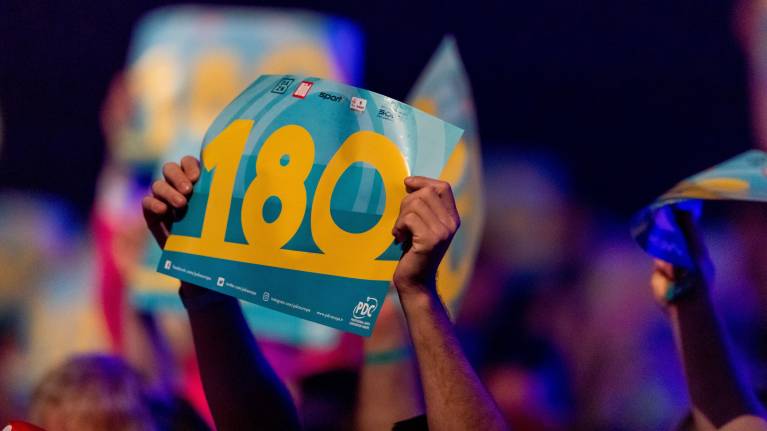
Landing a dart – also called an arrow – in a large black or white section gives the player a score of whatever value “slice” the section is within. For example, hitting either large black or white section within the “slice” labelled with a number 6 would give a score of 6. Hitting the doubles section of the same “slice” would score 12 (double 6), and hitting the trebles section would score 18 (treble 6). The highest possible score with 3 darts is 180, comprised of a trio of treble 20s. A score of 180 is invariably greeted by loud cheers from the crowd at live events; it is an incredibly difficult score to achieve, but professionals sometimes make it look easy.

Within the inner circle – called the “bullseye” – at the middle of the board, the scores are unchanging: hitting the outer ring (the “outer bull”) always scores 25 and hitting the smaller circle (the “bull” or “inner bull”) always scores 50. The term “bullseye” may also be used to refer to just the inner circle, excluding the outer ring.
For example, if a player hit treble 20, double 17, and the outer bull during their turn, their total for that turn would be 119:
60 (treble 20) + 34 (double 17) + 25 (outer bull) = 119
A single leg (or game) in darts sees players take turns to throw 3 darts at the numbered board. Their score is then subtracted from a total (usually 501). For example, if a player started their turn on 501 (a standard starting total), and scored the above points, their score at the end of that turn would be 382:
501 – 119 = 382
To win a leg of darts, players must “checkout” before their opponent. Checking-out requires reaching a score of 0 exactly, with the final dart thrown landing in a doubles section or the (inner) bull. Checking-out from a high total – the highest possible checkout is 170 – is a key skill among professional competitors, and successful large checkouts are usually greeted rapturously by spectators. If a player’s score dips below 0, that turn’s darts are voided, and they return to their previous positive score, come their next turn. The minimum number of darts needed to check-out is 9, but this is incredibly hard to do, requiring every throw to be perfect. Scoring a “9-darter” is therefore one of the greatest feats in darts, and arguably no other moment triggers such wild celebrations from a darts crowd than a check-out on the ninth dart.
In most professional darts competitions, the player who checks-out first wins a “leg”, and winning a certain number of legs brings a “set” – typically, sets are played on a first-to-5-legs basis. The number of sets required for a match win differs between different competitions and across different rounds of the same competition, but the most sets required for a match win is usually 7, and the fewest is usually 3. Some competitions are played in a leg format, meaning players must simply reach a predetermined number of legs first to win a match, without the need for sets.
Darts Key Rules
The following are phrases related to key rules in darts:
- 501: a game where players begin with 501 on the board and work their way down to zero
- 301: the same as 501, but beginning at 301 instead
- Leg: a single game
- Set: a collection of legs (a single set is usually the best-of-5 legs)
- Match: a full contest, comprising a race to an agreed number of legs or sets
- Double Start: a format where players must start the game with a double, as well as finish it with a double
Darts Season Format
The PDC darts season features over 40 tournaments a year. World ranking points can be earned in each event, and money won goes towards the PDC Order of Merit – a table system that ranks the tour’s top earners over a 2-year period. Players towards the top of the World Rankings and Order of Merit are considered some of the very best in the world.
Most PDC events take place within a weekend, or number of weeks, at the same venue, with a set amount of prize money and world ranking points up for grabs. Occasionally, larger events, or “series”, may be held over several weeks, or months, at a variety of different venues. The most famous of these “series” tournaments are Premier League Darts and the World Series of Darts. Both events collate their own standings and in-tournament rankings, but money won and world ranking points earned still go towards the PDC’s larger Order of Merit and World Rankings.
Take a closer look at the 2025 PDC darts schedule here.
Famous Darts Players
While Phil “The Power” Taylor remains the most famous darts player in history, here’s a quick look at some of the PDC’s top current stars:
- Luke Littler – youngest player to win multiple PDC titles, Luke “The Nuke” is at the forefront of darts’ rising popularity
- Michael Van Gerwen – 3-time World Champion who has dominated the game for years
- Luke Humphries – current World Number 1 and one of the game’s most consistent performers
- Peter Wright – 2-time World Champion known for his exuberant outfits and colourful mohawk

Darts Terms Glossary
The following are key terms you are likely to see or hear during a darts event:
- Arrows: slang term for darts
- Bullseye: centre of the board
- Break of Throw: winning a leg when your opponent went first
- Nine Darter: winning a leg with just 9 darts – a perfect game
- Oche: Where players throw from (7 feet, 9 and 1 quarter inches from the board)
Attending a Darts Event
If you’re interested in attending a darts event, check out the following links: