

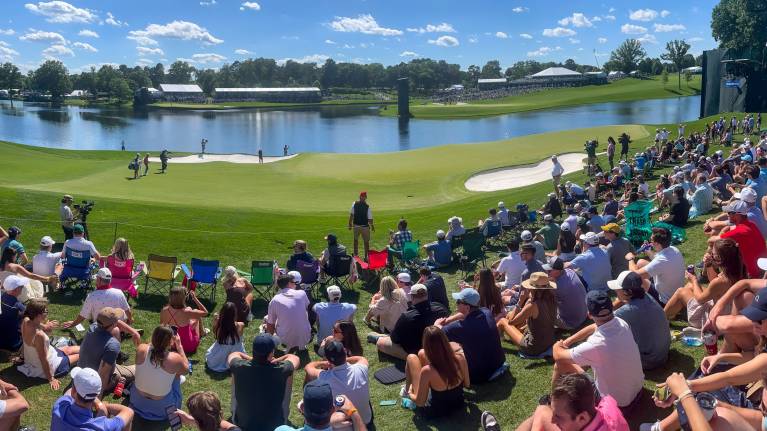
As the world’s premier men’s golf tour, the PGA Tour has been entertaining fans for close to a century, both across the United States – where the majority of its events are held – and around the globe. Despite competition from the DP World Tour and more recently LIV Golf, the PGA Tour has always starred the best players that golf has to offer, from Jack Nicklaus and Sam Snead to Tiger Woods and Rory McIlroy, playing on some of the world’s best courses. The result is world-class sporting entertainment and drama! Here, we’ll take you through everything you need to know about the PGA Tour.
- PGA Tour History
- PGA Tour Event Format
- PGA Tour Key Rules
- PGA Tour Season Format
- Famous PGA Tour Golfers
- PGA Tour Terms Glossary
- Attending a PGA Tour Event
PGA Tour History
The Tour can trace its origins back to 10 April 1916, with the founding of the Professional Golf Association of America, although it was not until 1929 that the existing collection of professional events became formalized into a year-round schedule, known at the time as “The Circuit.”
In 1968, it became an independent entity when Tour professionals split from the PGA of America amid a dispute over the revenue that came with increasing television coverage and popularity, as legendary players such as Arnold Palmer, Jack Nicklaus, and Gary Player captured the imagination of fans around the world.
In 1975, the name PGA Tour was adopted. Women have been allowed to join the PGA Tour since 1978, but to date no women have done so; a select number of female players have made appearances in PGA Tour events over the years, however, including Babe Didrikson Zaharias, Annika Sorenstam, Michelle Wie West, and Lexi Thompson. The PGA Tour Champions senior and Korn Ferry Tour developmental circuits were established in 1980 and 1989, respectively, both operating under the PGA Tour banner.
Today, PGA Tour events are contested by the best golfers from the US and around the world, including stars such as Tiger Woods, Rory McIlroy, and Scottie Scheffler.

PGA Tour Event Format
Although the exact scoring formats do occasionally differ, as in any golf event, the primary objective of any player competing in a PGA Tour event is to complete each hole and each round in the fewest number of strokes. Full-field PGA Tour events are contested by approximately 156 players, although some competitions will feature smaller, more exclusive fields.
PGA Tour Event Duration
Most PGA Tour events are contested over 4 days, Thursday-Sunday, although most competitions will also feature practice rounds or Pro-Am days earlier in the week that fans may be able to attend. Each day is a different round, unless weather delays prevent a round from being completed, in which case it may be resumed the following day. Players tee off throughout the morning and the afternoon; play will often start around 07:00 and can last until 17:00 or 18:00, particularly over the first 2 days when the entire field is competing.
Scoring & Winning a PGA Tour Event
Most events are held in the standard stroke play format, in which the winner is the player with the lowest number of strokes across all rounds. PGA Tour events are typically held over 4 rounds of 18 holes apiece, for a total of 72 holes played. Depending on weather conditions and the difficulty of the course, the winning score could range anywhere from around 22-under par to 2-over, although it is very rare for a tournament to be won with a score exceeding par.
Should 2 or more players be tied on the same score at the end of the final round, they proceed to a sudden death playoff, in which they replay select holes until they can be separated.

PGA Tour Key Rules
The following are some key rules on the PGA Tour:
- Lost/Out of Bounds – if a ball is lost or hit outside the boundary of a hole, players must take 1 penalty stroke and return to the spot of their previous stroke, also known as playing “under stroke and distance.”
- Penalty – players might incur an additional stroke on their scorecard, such as if their ball is lost or hit out of bounds. Some infractions, such as hitting the wrong ball, can incur 2 penalty strokes.
- Shotgun Start – when play begins on all holes simultaneously.
- Stroke Play – the most common format in golf and on the PGA Tour, whereby the player with the lowest number of total strokes at the end of the tournament wins.
- Match Play – a format in which a player or team earn points for each hole in which they better their opponent’s score, and the winner is the player or team with the most points at the end of the competition.
- Four-ball – this is a match contested by 2 teams of 2, in which each hole is won by the team whose member scored lowest.
- Foursome – also known as “Alternate Shot,” this is a match contested by 2 teams of 2, in which the teams use 1 ball each and take alternating shots on each hole.
PGA Tour Season Format
The PGA Tour season runs in a calendar-year format with the season starting in January and finishing in November or December.
Players competing on the Tour earn FedEx Cup points in addition to prize money, with 500 on offer to the winner of most events. The majors offer 750 points to the winners, while the Players Championship and a selection of "signature" PGA Tour events (The Sentry Tournament of Champions, AT&T Pebble Beach Pro-Am, Genesis Invitational, Arnold Palmer Invitational, RBC Heritage, Wells Fargo Championship, Memorial Tournament, and Travelers Championship) reward their winners with 700 as well as additional prize money. Some top players will often split their time between the PGA Tour and DP World Tour's biggest events, as their strong performances are typically enough for them to qualify for both Tours' season-ending events even if they don't feature every week.

At the end of the regular season in August, the top 70 FedEx Cup points winners qualify for the FedEx Cup Playoffs. The playoffs consist of the final 3 events of the season, culminating in the Tour Championship. At the end of the Tour Championship, the player with the most points is crowned the season champion and claims the FedEx Cup.
The remainder of the season from September onwards is known as the FedEx Cup Fall, which determines qualification for the top 125 players for the following season. You can find out more in Koobit’s full PGA Tour Schedule Guide.
Famous PGA Tour Golfers
Some of the PGA Tour’s top stars include:
- Tiger Woods – perhaps the most famous golfer of all time, Woods has 15 major titles to his name and a joint-record 82 PGA Tour wins.
- Rory McIlroy – McIlroy has spent more than 100 weeks as world no. 1 over the course of his illustrious career, which includes multiple major titles and a record number of FedEx Cup wins.
- Jack Nicklaus – nicknamed the “Golden Bear,” Nicklaus holds a record 18 major titles and has also designed many golf courses.
- Sam Snead – with Woods, Snead holds the joint record of 82 PGA Tour wins, having racked up 142 victories in his professional career.

PGA Tour Terms Glossary
- Par – the number of strokes a player is expected to complete a hole or a round in. For example, holes are often par 3, 4, or 5, while an 18-hole course is usually around par 72.
- Birdie – finishing a hole 1 stroke under par.
- Eagle – finishing a hole 2 strokes under par.
- Albatross – also known as a double eagle, finishing a hole 3 strokes under par.
- Hole-in-One – also known as an ace, scoring with your first shot on a hole, usually only achievable on a short par 3.
- Bogey – finishing a hole 1 stroke over par.
- Double Bogey – finishing a hole 2 strokes over par.
- Triple Bogey – finishing a hole 3 strokes over par.
- Tee – a stand used to elevate the ball for the first shot (also known as the tee shot) on each hole. The area in which the tee is placed is known as the tee box.
- Green – the closely manicured area directly surrounding the hole, which requires a putter.
- Fairway – the mown area of grass that leads from the tee to the green.
- Rough – the longer grass that borders the fairway; it is more difficult to play from than the fairway.
- Water Hazard – ponds, lakes, or rivers that are built into the course to provide added challenge for the players to avoid.
- Bunker – also known as a sand trap, bunkers are areas of sand that line a fairway or surround a green to provide added challenge for the players to avoid.
Attending a PGA Tour Event
If you’d like to attend a PGA Tour event, then you’ll find the following links helpful: