

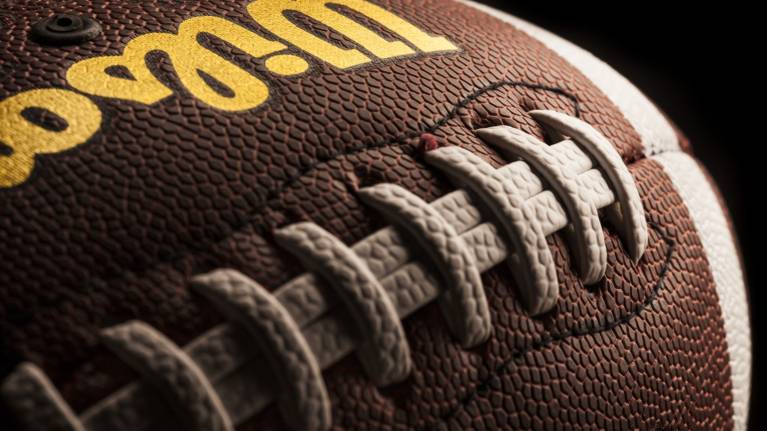
The National Football League, or NFL, is a professional American football league based in the United States. The organization represents the highest level of competition for the USA’s favorite sport.
From stadiums to crowd noise, tackles to score lines – everything is bigger in the NFL. Each season, the league’s famous teams clash in supersize spectacles, with some of the world's biggest, fastest, and strongest athletes battling it out on the gridiron. The result is a global sporting phenomenon with the highest average attendance of any professional sports league on the planet. For sports fans in search of fierce action, nail-biting drama, and colorful party atmosphere, the NFL has it all.
- NFL History
- NFL Game Format
- NFL Player Positions
- NFL Key Rules
- NFL Season Format
- Famous NFL Players
- NFL Terms Glossary
- Attending an NFL Game
NFL History
The NFL was founded in 1920 as the American Professional Football Association, becoming the National Football League in 1922. It was developed to improve the quality of professional football, which at the time was still largely secondary to college football, and to create new structures for player recruitment and game scheduling.
In 1966, the NFL merged with its rival, the American Football League (AFL). Although the new joint league kept the NFL name, it was now divided into 2 conferences: the National Football Conference featuring the original NFL teams, and the American Football Conference comprising the AFL teams. The first Super Bowl was held in 1967, setting the 2 conference champions against each other to decide a single NFL Champion.
Between 1970 – 1990, interest in the NFL grew spectacularly. Major TV contracts soon followed, helping to increase the league’s profitability, and during the period 1995 – 2002, four new franchises were added to the mix, taking the NFL to its current total of 32 teams.
Today, the NFL continues to gain in popularity – not just in North America, but around the globe. Alongside other key initiatives, such as efforts to make American football safer, Commissioner Roger Goodell has introduced NFL’s International Series, which has seen regular season games take place in the UK, Germany, Mexico, and Brazil. Delivering one of the most colorful, fast-paced, and hard-hitting experiences in sport, NFL games drew 18.85 million fans in 2023 and over 200 million fans tuned-in to the Super Bowl.

NFL Game Format
NFL games are contested between 2 teams of 11 players. These players can be changed via unlimited substitutions, resulting in totally different offensive and defensive lineups that rotate throughout a game.
The objective of an NFL game is for a team to score more points than their opponents. As a territorial sport, American football is essentially the battle between two teams aiming to invade their opponent's end zone, at the opposite end of the field, with the ball.
NFL Game Duration
NFL games have a total time limit of 60 minutes, split into 4 quarters of 15 minutes each. Due to the various breaks and pauses that are part of an NFL game, as well as the fact that the clock can stop at certain times, the average NFL game lasts around 3 hours.
Scoring & Winning an NFL Game
In an NFL game, points can be scored in various ways. Generally, teams attempt to move the ball into the opposition’s end zone, either by running with it, or by throwing and catching it. A team with possession of the ball in their opponent’s end zone earns a touchdown – the highest scoring act in American football, worth 6 points.
On offense, a team starts with 4 plays, or “downs,” which they can use to move the ball towards their opponent’s end zone. The leader of the offense is the quarterback, a throwing specialist who can carry the ball themselves or pass the ball to other players. A play ends when a player is tackled, when the ball goes out of play, or when a pass hits the ground without being caught.
During their first 4 downs, if a team advances 10 yards or more in total, their downs reset and they receive 4 more downs with which to advance at least another 10 yards (and so on). If a team does not advance at least 10 yards after 4 downs, possession of the ball switches to their opponents. In preparation for this, an offensive team may sometimes use fourth down to kick for a good territorial position, or try for a field goal. A field goal, worth 3 points, involves kicking the ball between the uprights at the end of the playing area. It is the second most common way of scoring.

When on defense, American football teams aim to prevent their opponents from entering their end zone, or better yet, prevent them from gaining at least 10 yards. Some of the most effective defensive plays are interceptions or forced fumbles, whereby the defensive team gain control of the ball and immediately take over on offense.
The team with the most points at the end of an NFL game wins. If teams are tied when the 60 minute time limit expires, NFL games go to overtime. Overtime is a 10-minute period of play in which the first team to score a touchdown, or the first team to score any points after both teams have had possession, wins. In the regular season, if teams are tied after overtime, the game ends in a tie. In the playoffs, overtime continues a quarter at a time until there is a winner.
NFL Player Positions
NFL positions are divided into three main units: Offense, Defense, and Special Teams. Players on offense and defense tend to play as part of these units exclusively (i.e. an offensive player is unlikely to play on defense), whereas, aside from a few specialist positions, Special Teams units can be made up of players from both the offense and defense.
Below is a list of the positions you're likely to come across in an NFL game, along with a short description of the position requirements, and the ideal player profile. Brackets contain the position abbreviation and the number of players in that position required on the field when the offense/defense is active.
Offense
- Center (C) (1) · Lines up at the center of the offensive line, in front of the quarterback; big, strong player who can snap the ball to the QB and block the defense.
- Offensive Tackle (OT) (2) · Line up in the offensive line, either side of the Center; big, strong players who block the defense.
- Offensive Guard (OG) (2) · Line up in the offensive line, either side of the Tackles; big, strong players who block the defense.
- Quarterback (QB) (1) · Lines up behind the Center; offense’s leader and most influential player, with a good throwing arm; receives the ball from the center and either throws it downfield, hands it off to a running back, or runs with the ball himself.
- Running Back (RB) (1–3) · Can line up behind/beside the QB, as well as in a wider receiver position; quick, strong players that can be handed the ball for a run, receive the ball in the air, or block the defense.
- Wide Receiver (WR) (2–4) · Line up wide of the offensive line; can block, but generally speedy players that run various routes in opposition territory, trying to find space where they can catch, and advance, the ball.
- Tight End (TE) · Line up near the offensive line; tall, powerful players that can both block and catch.
Defense
- Defensive Tackle (DT) (1–2) · Lines up at the center of the defensive line; powerful players who attempt to stop running plays and tackle the quarterback.
- Defensive End (DE) (2) · Line up outside the Tackles on the edge of the defensive line; explosive players who aim to tackle the quarterback and stop running plays going wide.
- Middle Linebacker (MLB) (1–2) · Sometimes called the “Quarterback of the defense” due to their leadership and defensive play-calling; versatile players who line up centrally, behind the defensive line, and must be able to stop run plays, defend central passes, and rush the quarterback.
- Outside Linebacker (OLB) (2) · Line up either side of the Middle Linebackers; strong and quick players capable of defending against receivers and rushing the quarterback.
- Cornerback (CB) (2–3) · Line up in wide positions opposite Wide Receivers; fast, agile players capable of containing runs, but mainly tracking receivers and disrupting/intercepting passes.
- Safety (S) (2) · Line up in deep, central positions, far from the ball; fast, agile players that act as a last line of defense in passing, and sometimes running, situations.
Special Teams
- Kicker (K) (1) · An accurate kicker who attempts to kick the ball through the posts in field goal situations.
- Punter (P) (1) · A powerful kicker who kicks the ball from their hands deep into opposing territory on fourth down. This helps the kicking team move away from their own end zone for when their opponents take control of the ball.
- Long Snapper (LS) (1) · Specialist centers who can snap the ball a long way on kicking plays.

NFL Key Rules
The following are phrases related to key rules in the NFL:
- Down · A short period in which play takes place. A down begins with the center snapping the ball, and generally ends when the player with the ball is tackled, goes out of bounds, or scores.
- Fourth Down · On offense, teams get four ‘downs’ (think plays or chances), with which to move the ball at least 10 yards. Fourth down is a team's final chance to make it 10 yards. If they go for it on fourth down and succeed, the downs reset and they start again with first and 10 (first down, 10 yards to go). If they fail to make it past the 10 yard marker, they hand the ball over to the opposition on the same spot. This is why many teams punt for territory, or kick a field goal if possible, on fourth down.
- First Down · The beginning of a new set of downs. Can be triggered by a team progressing 10 yards on the previous set of downs.
- Touchdown · Highest-scoring play in American football, worth 6 points. A player scores a touchdown for their team by entering the opponent’s end zone with the ball, or catching a pass in their opponent’s end zone.
- End Zone · The 10 x 53-yard scoring zones at each end of the field.
- Extra Point · After a touchdown, teams can choose to earn one extra point by kicking a 33-yard field goal. Alternatively, they can try for a two-point conversion.
- Two-Point Conversion · Instead of kicking the extra point, teams that have just scored a touchdown can earn an extra 2 points by running the ball across the goal line or catching the ball in the end zone. NFL’s 2-point conversions begin at the 2-yard line, making it a risky play, but one that starts much closer to the end zone than an extra point.
- Field Goal · A kick that passes through the uprights, worth 3 points (or just 1 when it is taken as an "extra point" directly after a touchdown).

- Fumble · When a player loses control of a live ball. A fumble recovery from the opposing team results in a turnover.
- Turnover · When a defensive player gains legal possession of a live ball, usually via fumble or interception. The defensive player’s team can then take over on offense.
- Interception · Another form of turnover – when a defensive player catches a pass attempt by the offense, resulting in a change of possession.
- Turnover on Downs · When a team fails to progress 10 yards in total after 4 ‘downs’, resulting in a change of possession at the ball’s last spot.
- Penalty · An infringement of the rules that usually results in a loss of yardage. Common penalties include holding (illegally grasping an opponent) and offside (a player moving too early and ending up on the wrong side of the ball when it is snapped).
- Sack · When a defensive player tackles a quarterback who is still in possession of the football.
- Safety · When an offensive player is tackled inside their own end zone. This play results in 2 points, and possession of the ball, for the team that caused the safety.
- Two-Minute Warning · A stoppage in play at the 2-minute mark in the second and fourth quarters.

NFL Season Format
The NFL contains 32 teams, split across 2 conferences: the National Football Conference (NFC) and American Football Conference (AFC). Within these conferences, teams are spread across 4 geographical divisions with 4 teams in each. These are the NFC/AFC North, NFC/AFC South, NFC/AFC East, and NFC/AFC West.
Regular Season
NFL teams play 17 regular season games each, including 2 games against each of their in-division opponents. NFL standings are worked out using win percentage – for example, a team with a 10–7 win/loss record would have a .588 win percentage. Teams are ranked within their divisions, and the wider conference, depending on the percentage of games they have won. Once all regular season games have been played, 14 teams qualify for the NFL playoffs – the 8 division winners, plus 3 wildcards from each conference with the next-best records.
Playoffs
The NFL playoffs are a bracket-style elimination competition designed to determine the NFL’s best team for the season. The 14 teams taking part are first seeded, depending on their regular season finishing positions, with the top team from each conference given a bye through to the second round of the playoffs. Following a Wild Card Round, and a Divisional Round, the remaining 4 teams play out the AFC and NFC Conference Championships to determine the NFC and AFC Champions. These 2 teams then compete in a single decisive game – the Super Bowl – for the Lombardi Trophy and the chance to call themselves NFL champions.
For a full rundown of how the season works and the teams involved, check out our NFL Schedule Guide.
Famous NFL Players
These stars are among NFL’s top current players:
- Patrick Mahomes (Kansas City Chiefs) · A 3-time Super Bowl winner, Mahomes is a quarterback with unique skills and supreme abilities that have already seen him enter NFL’s GOAT (Greatest of All Time) debate.
- Travis Kelce (Kansas City Chiefs) · One of the NFL's very best tight ends, whose fame recently skyrocketed after he began dating pop sensation Taylor Swift.
- Aaron Rodgers (New York Jets) · Charismatic, gunslinging quarterback looking to win the New York Jets a Super Bowl before he hangs up his boots.
- Odell Beckham Jr (Miami Dolphins) · Colorful character and veteran highlight-reel receiver.
- Lamar Jackson (Baltimore Ravens) · Lightning fast, Jackson’s exciting approach to the quarterback position – which often involves running as much as it does passing – makes him a must-watch talent.

NFL Terms Glossary
The following are key terms you are likely to see or hear during an NFL game:
- Snap · A backwards pass made by the center, usually directed to the quarterback, that marks the start of a down.
- Shotgun · A position where the quarterback sometimes chooses to receive the snap, several steps behind the center.
- Pocket · The area around the quarterback – protected by the offensive line – where he receives the ball before passing or running.
- Red Zone · Nickname for the area between the 20 yard line and end zone.
- Blitz · A play where 4 or more defenders rush directly for the quarterback in an attempt to sack him before he releases the ball.
- Gridiron · Nickname for the grid-like field on which American football is played.
- Pick-Six · An interception that is returned for a touchdown.
- Pigskin/Rock · Slang terms for the ball.
Attending an NFL Game
If you’re interested in attending an NFL game, check out the following links: