

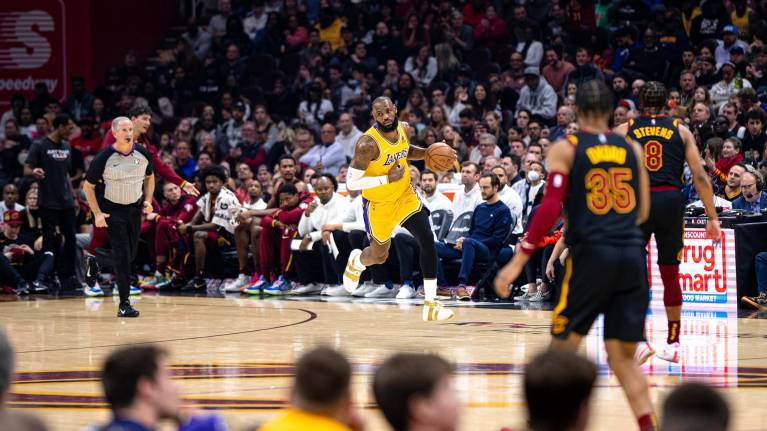
The National Basketball Association, more simply known as the NBA, is the premier men’s basketball league of the United States and Canada. It is renowned throughout the world as the most elite professional basketball competition on the planet, watched live and on TV by millions of fans each year.
The stars of the NBA are known for their remarkable size, skill, and athleticism, unrivalled within the sport of basketball, and thanks to the league’s global popularity its biggest names are among the most recognizable athletes in the world.
- NBA History
- NBA Game Format
- NBA Player Positions
- NBA Key Rules
- NBA Season Format
- Famous NBA Players
- NBA Terms Glossary
- Attending an NBA Game
NBA History
The NBA was founded in 1946, known then as the Basketball Association of America. Walter Brown, owner of the Boston Garden arena, was struck with the idea of holding basketball games in major ice hockey venues on nights when hockey wasn’t being played, and it became the first attempt at playing professional basketball in substantial arenas in major cities around the United States. The BAA was renamed the NBA in 1949, when it merged with the rival National Basketball League.
A 24-second shot clock – still used to this day – was introduced in 1954 to encourage teams to shoot more frequently, and the sport continued to grow in the coming decades as the league expanded. The NBA enjoyed a surge in popularity in the 1980s thanks to the emergence of stars like Michael Jordan, Larry Bird, and Magic Johnson, and it is now enjoyed by basketball fans around the world with modern superstars like LeBron James and Steph Curry capturing the imagination of a global audience.
NBA Game Format
NBA games primarily utilize standard basketball rules, in which 2 teams of 5 players apiece compete to score the most points by putting the ball through their opponents’ hoop.
NBA Game Duration
Matches consist of 4 quarters of 12 minutes each for 48 minutes of total play time, plus overtime periods of 5 minutes each if the game is tied. With short breaks in between quarters and overtime periods – plus a 15-minute half-time break between the 2nd and 3rd quarter – and timeouts during play, games typically last around 2 hours and 30 minutes on average.

Scoring & Winning an NBA Game
A successful basket – known as a field goal – is worth either 2 or 3 points, depending on whether the shot is inside or behind the 3-point line. Free throws, which are awarded by the referee after a foul is committed, are worth 1 point, although a referee may award 1, 2, or 3 free throws at a time depending on the offence. Because of the incredible accuracy with which most NBA players shoot, one or both teams can easily exceed 100 points in most games. The most points ever scored by a team in an NBA game was 186, a record set by the Detroit Pistons in 1983.
On the relatively rare occasions that the teams are tied at the end of the 4th quarter, they will proceed to play 5-minute periods of overtime until they can be separated.
NBA Player Positions
There are 5 players on an NBA team, each of whom plays a different role on the court. They can be divided into the following 3 categories:
Guards
- Point Guard (1) – the team’s playmaker or “quarterback,” the point guard is typically the smallest player on the team (usually still exceeding 6’ tall) and focuses on using their passing, dribbling, and speed to dictate play and assist their teammates, although they can be effective shooters too.
- Shooting Guard (2) – also referred to as a wing, they typically operate outside the 3-point line and specialize in mid to long-range shooting, although they can also drive toward the basket for close-range efforts; players in this position may also operate in a more defensive manner and focus on limiting opportunities for their opposition’s biggest threat.
Forwards
- Small Forward (3) – typically the most versatile position on the team, they can be interchangeable with shooting guards and are considered the team’s all-rounder, whether they’re shooting, passing, defending, or assisting.
- Power Forward (4) – acting somewhere between a small forward and a center, these players focus on close and mid-range shooting on offense and guarding the basket on defense.
Centers
- Center (5) – typically the tallest player on the team, centers operate nearest the basket and focus primarily on close-range shooting or blocking opponent’s shots.

NBA Key Rules
Here are some of the key rules in the NBA:
- Shot Clock – the NBA utilizes a 24-second shot clock to increase the pace of play; this timer dictates how long the team in possession of the ball has to make a shot or concede possession to the other team.
- Traveling – in the NBA, a player in possession of the ball may not take more than 2 steps without dribbling.
- Carrying – also known as a “double dribble,” this is when a player places their hand underneath the ball and pauses their dribble before resuming.
- 3-Second Rule – players must not spend longer than 3 seconds at a time in their opponents’ key while their team is in possession of the ball.
- 8-Second Rule – when a team gains possession of the ball, they have 8 seconds to progress it into their opponents’ half of the court.
- Personal Foul – illegal contact between a ball-carrier and a defender, such as blocking, charging, pushing, holding, or elbowing.
- Flagrant Foul – in the NBA, this is a personal foul involving excessive or violent contact that could put the fouled player at risk of injury.
- Technical Foul – a foul committed via unsportsmanlike behaviour not involving physical contact, such as dissent toward an official, flopping, or some procedural violations.
- Turnover – a loss of possession, either during play or a penalty for a rule infraction such as a time violation.
- Free Throw – an unopposed shot at the basket from the free-throw line worth 1 point; referees may award 1, 2, or 3 free throws to a team after a foul is committed by their opponents.
- Timeout – a break in play requested by a player on the court or a head coach; NBA teams are permitted to call for 7 timeouts per game, and there are 2 mandatory timeouts per quarter.
- Overtime – if the 2 teams are tied at the end of the 4th quarter, the teams will play 5-minute periods of extra time until they can be separated. Usually, only 1 or 2 periods of overtime are required.
NBA Season Format
The league is comprised of 30 teams, all based in the US save for the sole Canadian representatives, the Toronto Raptors. The teams are split evenly into Eastern and Western Conferences, and within them 3 geographical divisions: Atlantic, Central, and Southeast in the former, and Northwest, Pacific, and Southwest in the latter.
Seasons typically run from early October to mid-June. The NBA season is broken up into the following stages:
Regular Season
In the regular season, each team plays 82 NBA games in an asymmetrical format. Every team plays all the opponents in the other conference twice (30 games). Within their own conference, they face the other teams in their geographical division and 6 teams from the other divisions 4 times (40 games), while the remaining 4 teams they play 3 times (12 games).
Points are not awarded for victory; rather, the teams are ranked within their conference by win-percentage.

Postseason
At the end of the regular season, the top 6 teams in each conference proceed directly to the NBA Playoffs postseason tournament. The final 2 playoff places for each conference are decided by a “Play-In Tournament” contested by the teams who finished 7th through 10th. Once the playoff line-up is complete, the 16 teams are separated into brackets by conference and battle through 3 knockout rounds – each a best-of-7 series of games – to determine the Eastern and Western Conference champions, who then face off in the NBA Finals to become the overall league champions.
Teams will then enter an offseason period before entering pre-season prior to the next campaign; you can find a full breakdown of the NBA season format in our complete NBA Schedule Guide.
Famous NBA Players
The NBA has produced a great many notable players over the years, from Wilt Chamberlain to Steph Curry.
It was the emergence of stars such as Kareem Abdul-Jabbar, Larry Bird, and Earvin “Magic” Johnson in the 1970s and 1980s that saw the league’s popularity soar and the players become household names. This trend continued over the decades that followed thanks to the likes of Charles Barkley, Shaquille O’Neal – better known simply as Shaq – and the late Kobe Bryant.
Here are some of the NBA’s biggest stars of past and present:
- Kareem Abdul-Jabbar – became the NBA’s all-time top points scorer in 1984, a record he held until 2023.
- Kobe Bryant – a 5-time NBA champion with the Los Angeles Lakers and 18-time NBA All-Star.
- LeBron James – has won NBA championships with Miami Heat, the Cleveland Cavaliers, and Los Angeles Lakers; he overtook Abdul-Jabbar as the all-time leading scorer in NBA history in 2023.
- Steph Curry – has won multiple NBA championships with the Golden State Warriors; the all-time leader in 3-pointers in NBA history, he is widely considered the league’s greatest ever shooter.
- Michael Jordan – the most famous basketball player in history; despite an 18-month stint as a Minor League Baseball player during that period, Jordan led the Chicago Bulls to 6 NBA championships between 1991 and 1998.

NBA Terms Glossary
- Key – also known as the free throw lane (or simply the lane) or the paint, this is the marked rectangular area of the court surrounding the basket.
- 3-Pointer – a shot taken from behind the 3-point line.
- Rebound – the act of retrieving the ball after a missed shot at the basket, rebounds can be offensive or defensive in nature.
- Steal – regaining possession of the ball, either by intercepting a pass, interrupting a dribble, or (legally) slapping it out of an opponent’s hands.
- Flopping – akin to diving in football (soccer), this is the act of simulating or exaggerating contact in an attempt to draw a foul.
- Double-Double – achieving double-digit figures in 2 separate positive stats during a game, such as points and assists; doing so in 3 or more stats is known as a triple-double, and so on.
- Buzzer-Beater – a field goal scored in the final seconds before the buzzer sounds to signal the end of the game, particularly a shot that wins or ties the game for the scoring team.
- Alley-Oop – an offensive play whereby a player throws the ball up toward the basket for a teammate to jump and catch it before scoring in mid-air.
- Dunk – also known more emphatically as a slam dunk, this is a method of scoring by putting the ball directly through the basket with one or both hands rather than shooting.
- Layup – a one-handed shot that rebounds into the basket via the backboard.
- Elam Ending – a method of deciding a game by reaching a specified target score with no game clock used and no overtime played; for example, in some recent NBA All-Star Games, the 4th quarter has been untimed, with the target score being 24 points more than the leading team’s score at the end of the 3rd quarter.
Attending an NBA Game
If you’re thinking of attending an NBA game, please check out the following helpful links: