

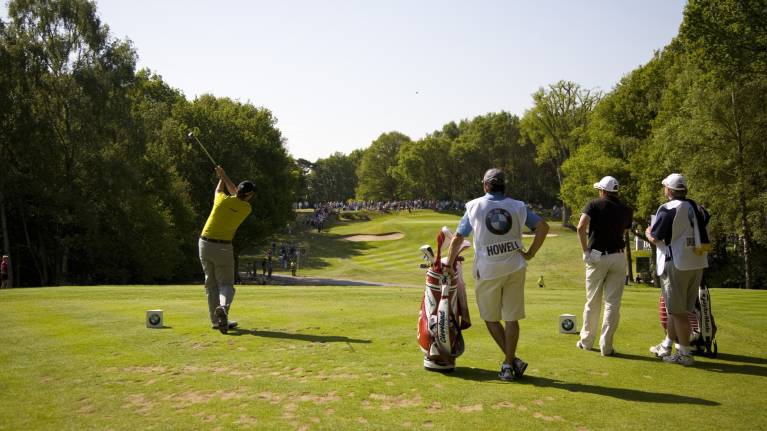
The European Tour, currently known as the DP World Tour for sponsorship reasons, is one of the world’s top professional men’s golf tours. Covering not only events across Europe but also around the world, the DP World Tour stands alongside the PGA Tour in filling the weekly golf calendar with top-class competitions, including a range of national opens. From Rory McIlroy and Viktor Hovland to Jon Rahm and Tommy Fleetwood, DP World Tour events are home to some of the world’s biggest and best golfers. Here, we’ll take you through a crash course on this historic golfing institution.
- DP World Tour History
- DP World Tour Event Format
- DP World Tour Key Rules
- DP World Tour Season Format
- Famous DP World Tour Golfers
- DP World Tour Terms Glossary
- Attending a DP World Tour Event
DP World Tour History
Professional golf began in Scotland – where the game itself was invented – in the 18th and 19th centuries, and by the 20th century there were not only tournaments throughout the United Kingdom and Ireland, but also across the continent.
As interest in golf flourished post-World War II with the advent of television coverage and increasing prize money for the players, the European Tour was established by the British-based Professional Golfers’ Association in 1972, combining these disparate tournaments into an integrated tour.
Over the years, it increasingly took on a global scale with many of its ranking events held around the world, first branching out into Asia with the inaugural Dubai Desert Classic in 1989.
Along with the majors and formerly the World Golf Championships, which became part of the European Tour schedule in the 1990s, in recent years it has also begun collaborating with the PGA Tour as part of a “strategic alliance” that has seen them co-sanction several US-based events.
It took on the DP World Tour name from the 2022 season, its 50th anniversary, as part of a lucrative sponsorship deal that increased the prize money – and the calibre of players on show – at each event.

DP World Tour Event Format
While the exact scoring format occasionally varies on the DP World Tour, the goal always ultimately remains the same for the players, as in any golf competition – score as few strokes as possible on each hole and across each round. A full-field event will typically have up to around 156 players, but some might feature smaller or more exclusive line-ups.
DP World Tour Event Duration
Like most golf tournaments, DP World Tour competitions are typically held over 4 days, spanning Thursday through Sunday. Some events open practice rounds or Pro-Am days to the public earlier in the week. Tournament rounds typically begin early, sometimes around 07:00, and may not finish until 18:00. Over the weekend, when half the field has usually been cut, it may not start quite as early or finish as late.
Scoring & Winning a DP World Tour Event
The majority of DP World Tour events are held in the standard stroke play format, where the player who finishes with the lowest number of strokes across all 4 rounds is crowned the winner. Each round is comprised of 18 holes, for a total of 72. A playoff is required if 2 or more players are tied atop the standings at the end of the 4th round.
Winning scores can vary enormously depending on the course and the weather conditions; you might see a player win with 25-under par or 2-under.

DP World Tour Key Rules
The following are some key rules on the DP World Tour:
- Lost/Out of Bounds – if a ball is lost or hit outside the boundary of a hole, players must take 1 penalty stroke and return to the spot of their previous stroke, also known as playing “under stroke and distance.”
- Penalty – players might incur an additional stroke on their scorecard, such as if their ball is lost or hit out of bounds. Some infractions, such as hitting the wrong ball, can incur 2 penalty strokes.
- Shotgun Start – when play begins on all holes simultaneously.
- Stroke Play – the most common format in golf and on the DP World Tour, whereby the player with the lowest number of total strokes at the end of the tournament wins.
- Match Play – a format in which a player or team earn points for each hole in which they better their opponent’s score, and the winner is the player or team with the most points at the end of the competition.
- Four-ball – this is a match contested by 2 teams of 2, in which each hole is won by the team whose member scored lowest.
- Foursome – also known as “Alternate Shot,” this is a match contested by 2 teams of 2, in which the teams use 1 ball each and take alternating shots on each hole.

DP World Tour Season Format
The DP World Tour season typically runs from November to November. You can find Koobit’s full DP World Tour Schedule Guide here.
In addition to prize money, players compete for Race to Dubai points based on their performance, with winners receiving between 2,000 and 10,000 points depending on the event. The European Tour’s Race to Dubai is the equivalent of the PGA Tour’s FedEx Cup, which gives the players a season-long goal to compete for.
At the end of the season, the top 50 players qualify for the DP World Tour Championship, held on the Earth course at Jumeirah Golf Estates, which offers the most Race to Dubai points (12,000) and boasts the highest prize fund of any exclusive DP World Tour event. At the conclusion of the season finale, the player with the most points is crowned European Number One and awarded the Harry Vardon Trophy.
Famous DP World Tour Golfers
Some of the DP World Tour’s biggest stars of past and present include:
- Rory McIlroy – as well as more than 100 weeks as world no. 1 and several major title wins, McIlroy has won the Race to Dubai more than any other player since its introduction in 2009.
- Jon Rahm – the Spaniard has won multiple major titles as well as racking up victories across the DP World Tour, PGA Tour, and LIV Golf.
- Seve Ballesteros – one of golf’s most beloved figures, the late great Seve Ballesteros collected 5 major titles and 6 Harry Vardon Trophies, as well as record 50 European Tour titles.
- Colin Montgomerie – holds a record 8 Harry Vardon Trophies, including 7 consecutive victories from 1993 to 1999.

DP World Tour Terms Glossary
- Par – the number of strokes a player is expected to complete a hole or a round in. For example, holes are often par 3, 4, or 5, while an 18-hole course is usually around par 72.
- Birdie – finishing a hole 1 stroke under par.
- Eagle – finishing a hole 2 strokes under par.
- Albatross – also known as a double eagle, finishing a hole 3 strokes under par.
- Hole-in-One – also known as an ace, scoring with your first shot on a hole, usually only achievable on a short par 3.
- Bogey – finishing a hole 1 stroke over par.
- Double Bogey – finishing a hole 2 strokes over par.
- Triple Bogey – finishing a hole 3 strokes over par.
- Tee – a stand used to elevate the ball for the first shot (also known as the tee shot) on each hole. The area in which the tee is placed is known as the tee box.
- Green – the closely manicured area directly surrounding the hole, which requires a putter.
- Fairway – the mown area of grass that leads from the tee to the green.
- Rough – the longer grass that borders the fairway; it is more difficult to play from than the fairway.
- Water Hazard – ponds, lakes, or rivers that are built into the course to provide added challenge for the players to avoid.
- Bunker – also known as a sand trap, bunkers are areas of sand that line a fairway or surround a green to provide added challenge for the players to avoid.
Attending a DP World Tour Event
If you’re considering attending a DP World Tour event, the following links will take you through everything you need to know: