

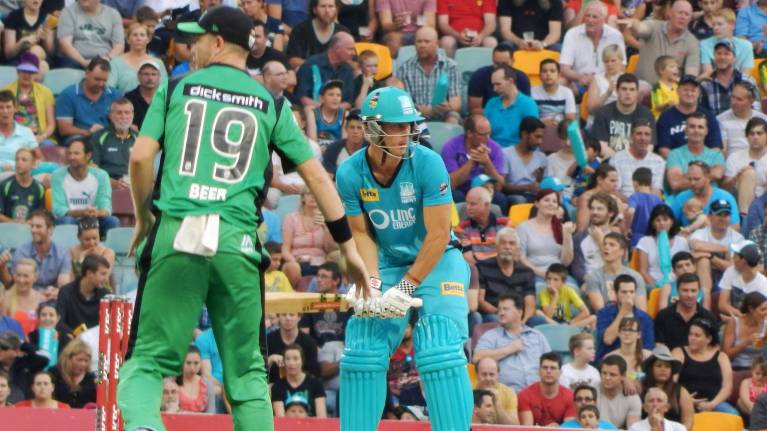
The Big Bash League, or BBL, is an annual men’s domestic cricket tournament played across Australia. Hosted throughout December and January, the competition is preceded by a women’s equivalent (the WBBL), and shares many similarities with other domestic franchise competitions like the IPL. A summer tradition for many Australians, Big Bash games are known for their family-friendly atmosphere and fast-paced action. In 2023-24, over 1 million fans flocked to see BBL matches live, in what has become one of the world's most colourful and star-studded celebrations of cricket.
- BBL History
- BBL Game Format
- BBL Player Positions
- BBL Key Rules
- BBL Tournament Format
- Famous BBL Players
- BBL Terms Glossary
- Attending a BBL Game
BBL History
Launched in 2011, the Big Bash replaced Australia’s existing domestic T20 competition, the Twenty20 Big Bash, with a view to adopting the franchise format successfully employed by the IPL. Rather than the 6 traditional state teams that had taken part in the tournament previously, the Big Bash League, or BBL, adopted 8 city-based franchises: one team for Adelaide, Brisbane, Hobart, and Perth, and 2 teams each for Melbourne and Sydney. Leaning into the competition’s fan-centred approach, a public design contest was held to determine the appearance of the BBL trophy. BBL|1, the tournament’s inaugural edition, began on 16 December 2011 as Sydney Sixers defeated Brisbane Heat at Sydney Cricket Ground.
In 2014, it was announced that a women’s version of the tournament would soon begin, featuring the same franchises as the BBL. The Women’s Big Bash League (WBBL) launched in 2015, and has since run alongside, or ahead of, the men’s tournament each year.

For over a decade now, the BBL has been a part of the Australian summer, with millions of viewers watching on TV each year. International coverage has further increased the BBL’s popularity, and the tournament regularly features on lists ranking the world’s top sports leagues by average attendance.
While expansion has occasionally been discussed, with Canberra, Geelong, and the Gold Coast mooted as possible team locations, the BBL continues to operate with 8 franchises. In contrast, the tournament’s format has changed on a number of occasions. Most recently, concerns over the season being too long led to the 2023-24 tournament being shortened from 61 games to a total of 44. This willingness to adapt has allowed the BBL to remain among the top domestic T20 leagues in the world, with over 1 million fans attending games during the competition’s 2023-24 edition – an average attendance of 22,852 per game.
BBL Game Format
BBL matches are played under standard T20 rules, with 11 players on each slide. The aim of any match is for a team to score more runs than their opponents.
Match Duration
In general, the format of a BBL match is as follows:
- Team 1 Innings (79-minute time limit)
- Short break for change of innings
- Team 2 Innings (79-minute time limit)
BBL matches generally last around 3 hours in total. Each team has 79 minutes to bowl their allotted 20 overs, and time taken beyond this limit can lead to fielding penalties. If a team is bowled out (i.e. all players are dismissed) during their batting innings, or if the second team batting reaches their target score with overs to spare, the game can sometimes end up being much shorter than 3 hours.
Scoring & Winning a BBL Game
In T20 cricket matches, like those played in the Big Bash, there are two innings (one for each team), limited to 20 overs each. During each innings, one team bowls and the other team bats.
The batting team’s goal during a BBL match is to score as many runs as possible. Runs are scored by hitting the ball into the outfield and running between the wickets before the bowling team can return it to the stumps. Each time both active batters make it safely to the opposite end of the strip, they earn a run. Runs can also be scored by hitting the ball across the boundary rope that surrounds the outfield. A ball hit across the rope with at least one bounce is worth 4 runs, while a ball hit over the rope with no bounces is worth 6.

The bowling team’s goal in a BBL game is to limit their opponent’s scoring, or get them "all out". A team is all out when 10 of their batters have been "dismissed" by being bowled, caught, stumped, run out, or otherwise deemed "out" by any other method.
The team with the most runs after both teams have batted in a BBL game is declared the winner. If the scores are tied at the end of a BBL game, a Super Over is played to break the deadlock. In a Super Over, each team tries to score as many runs as possible from 6 balls, with 2 wickets in hand. The team with the most runs after one over is victorious.
BBL Player Positions
All players in a cricket team bat (if required to) and field, but not all players bowl. Here’s a quick look at cricket’s main position categories:
Batters
These are players who specialize in batting and can usually be found towards the top of the batting order (1–4). Specialist batters are generally the team’s most skilful batters, and relied upon to adapt to the game situation – setting the tone early on, steadying a volatile innings if necessary, and ultimately, scoring enough runs to help the team win the game.
Bowlers
Though they have to bat too when called upon, these players specialize in bowling and trying to get the other team out. There are many different types of bowlers, but the most common are pace bowlers (who employ pace and bounce to get wickets) and spin bowlers (who try to bamboozle batters with balls that turn and spin). Specialist bowlers can bowl up to 4 overs each in a BBL game, and usually bat in the Lower Order (8–11).

Wicket Keepers
Wicket keepers are primarily good fielders, but also generally good batters too. They do not bowl, as when their team is fielding they “keep wicket”. This involves crouching directly behind the stumps and catching balls bowled that are left, missed, or edged by the batter. Wicket keepers are a vital part of any team, and usually bat in the Middle Order (5–7), but can bat anywhere. They are unique in that they are the only fielding player allowed to wear gloves.
All-Rounders
An all-rounder is a player with significant skill as both a batter and bowler. These are valuable players, especially in T20 cricket, as they can impact the game in both innings. All-rounders generally bat in the Middle Order (5–7), but can bat anywhere in the lineup. Highly versatile, they are some of the game’s most exciting players to watch.
BBL Key Rules
- Innings – a period in which a single team bats (in BBL games, both teams have 1 innings each in which to score their runs)
- Over – a set of 6 balls delivered by a bowler
- Boundary – the rope that surrounds the outfield, marking the edge of the playing area; also a name for shots hit beyond this rope that are worth 4 or 6 runs
- Four – a shot that sends the ball past the boundary rope with at least one bounce is worth 4 runs
- Six – a shot that sends the ball beyond the boundary rope with no bounces is worth 6 runs
- Wicket – the wooden stumps that batters must defend, but also the act of a bowler getting a batter out
- All out – when 10 players on the batting team have been dismissed (are out) and the innings, as a result, is over
- No-ball – an illegal delivery, usually as a result of the bowler stepping over the bowling crease line, which they must bowl behind
- Wide – an illegal delivery, where a bowler bowls too wide, out of reach of the batter
- Free hit – a free hit is granted to a batter when a bowler delivers a no ball; on a free hit, the batter cannot be caught or bowled, giving them a good chance of scoring

BBL Tournament Format
The structure of the BBL season is as follows:
Group Stage
The first round of the BBL is a modified round robin group stage. All teams play 10 games: a home or away tie against 4 teams, as well as home and away games against the remaining 3.
2 points are awarded for a win, 0 for a loss, and 1 for a game deemed a "no result" due to issues like bad weather.
After all round robin fixtures have been played, the top 4 teams with the most points advance to the playoff stage of the competition, while the remaining sides are eliminated.
Playoff Stage
The BBL playoff system is slightly unusual, but is designed to reward teams finishing higher in the table.
The structure of the playoffs is as follows:
The Qualifier: 1st-placed team v 2nd-placed team. The winner goes straight to the Final, while the loser stays in the competition.
The Knockout: 3rd-placed team v 4th-placed team. The winner advances to The Challenger and the loser is eliminated.
The Challenger: Loser of The Qualifier v Winner of The Knockout. The winner advances to The Final and the loser is eliminated.
The Final: Winner of The Qualifier v Winner of The Challenger. The victor is named Big Bash League Champion.
For more information on teams, fixtures, and tickets for BBL|14, take a look at our 2024-25 Big Bash League Schedule Guide.
Famous BBL Players
These stars will be among the BBL’s most recognisable players in 2024-25:
- David Warner (Sydney Thunder) – Thunder captain and former Australia opener
- Nathan Lyon (Melbourne Renegades) – popular Australian spinner
- Steve Smith (Sydney Sixers) – one of the greatest batters of all-time
- Ben Duckett (Melbourne Stars) – England opener and number 1 draft pick in 2024
- Lockie Ferguson (Sydney Thunder) – wicket-taking New Zealand fast bowler
- Glenn Maxwell (Melbourne Stars) – power-hitting Aussie known for hitting massive sixes
- Shai Hope (Hobart Hurricanes) – stylish batter and popular West Indian run-scorer
BBL Terms Glossary
- Duck – when a batter gets out without scoring any runs
- Strike rate (batter) – a stat that shows how quickly a batter scores, presented as the number of runs a batter scores per 100 balls
- Strike rate (bowler) – a stat that shows how often a bowler takes wickets, presented as the amount of balls bowled, on average, per wicket
- Hat-trick – when a bowler achieves 3 wickets in a row
- Yorker – a fast ball that pitches around the line of the batter’s feet, making it very difficult to hit
- Century – when a batter scores 100 runs without getting out
- Maiden – an over where no runs are scored
- DRS – short form of Decision Review System; teams have the opportunity to review an umpire’s decision in the BBL, but the perk is lost for the rest of the innings if the umpire’s original decision turns out to be correct