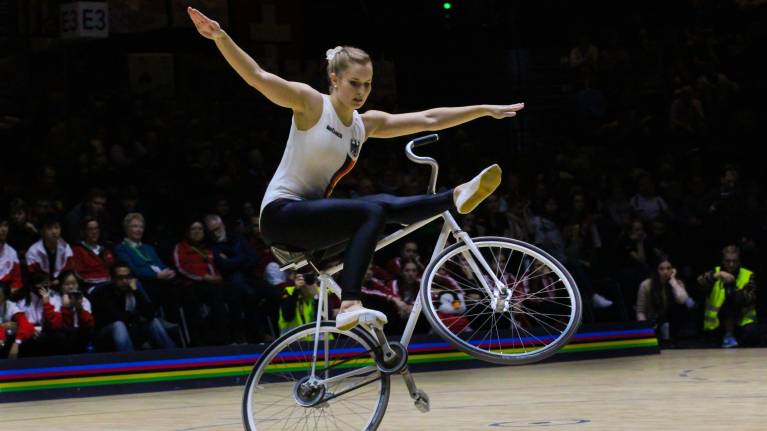
Indoor cycling is a competitive cycling discipline in which professionals compete in events for either artistic cycling or cycle ball. The 2 events are closely related due to the immense gymnastic skill and core strength needed for success.
The first unofficial world championships event in artistic cycling was held in 1888 by Swiss-American Nicholas Edward Kaufmann but it was largely considered a publicity stunt to showcase his tricks. Cycle ball was also first introduced by Kaufmann in 1893. Its first world championships were in 1929. Cycle ball is popular in Russia, Austria, Switzerland, Belgium, France, Czechia, and Germany, as well as in Japan.
The riding area for both competitions is a wooden court that ranges in dimensions from 9 x 12 metres to 11 x 14 metres, where the maximum size is required for international competitions.
Format & Scoring
Indoor cycling competitions are normally divided into 2 distinct disciplines (often these are both competed at the same 2-day event under the term of "indoor cycling"):
- Artistic cycling - a competitive indoor cycling format in which athletes perform tricks - known as "exercises" - for points on specialised fixed-gear bikes in a skill-based sport similar to gymnastics or ballet. The exercises are performed in front of judges in 5-minute rounds by singles, pairs, 4- or 6-person teams
- Cycle ball - also known as "radball", this is a sport similar to association football but played on bicycles. The 2 people on each team ride a fixed-gear bike with no brakes or freewheel. The ball is controlled by the bike and the head, except when defending the goal