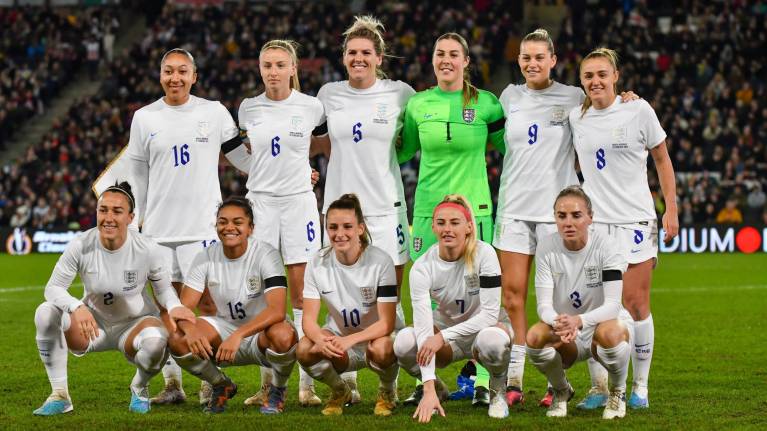
England women's football team, also known as the Lionesses, represent England in international football competitions such as the FIFA Women's World Cup and the UEFA European Women's Championship.
History
Despite the popularity of women's football in the late 19th and early 20th centuries – around 53,000 filled Goodison Park to watch Dick Kerr's Ladies on Boxing Day in 1920 – the Football Association banned women from playing in stadiums in 1921 on the grounds that "the game of football is quite unsuitable for females and ought not to be encouraged."
This ban would last 50 years. After it was rescinded, the Women's Football Association, which was formed in 1969 after an upsurge in football's popularity following the England men's FIFA World Cup triumph in 1966, were able to form a national women's team.
The Lionesses played their first match in 1972, beating local rivals Scotland 3-2 in what was Great Britain's first official international women's football match.
England reached the European Championship final on their debut in the competition in 1984, albeit the competition began at the semifinal stage with just 4 teams; they were defeated in the final by Sweden on penalties after drawing 1-1 on aggregate over 2 legs.
As the Lionesses have entered the modern, professional era of women's football, they have increasingly become a force on the world stage in recent years. As well as victories in minor tournaments such as the Cyprus Cup, SheBelieves Cup, and Arnold Clark Cup, their performances in major tournaments have improved significantly.
England reached the Euro 2009 final, where they were beaten by Germany, and they reached 3 consecutive semifinals in the 2015 and 2019 FIFA Women's World Cups either side of Euro 2017. This progress finally culminated in the Lionesses' first major trophy, which they won on home soil at Euro 2022.