

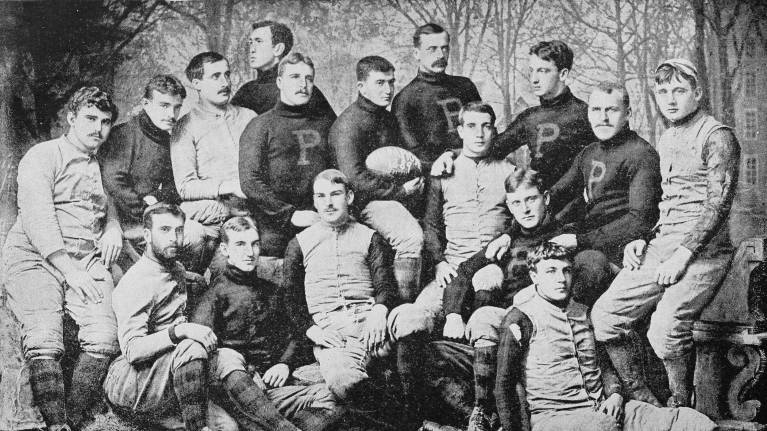
Looking at its incredible popularity across the US, it is difficult to imagine a time before American football existed. The sport is relatively new, however, tracing its origins to the late 19th century. So who invented American football, and how did it become the nation’s favourite sport?
- Origins of American Football
- Who Created American Football?
- How Did American Football Get Its Name?
- Early Days of American Football
- FAQs
Origins of American Football
Combination of Rugby and Soccer
Rugby and soccer were highly influential in the development of American football, which emerged as a sort of combination of the two existing sports. In the early days of American football, players disagreed about whether carrying the ball should be allowed, as it is in rugby, or forbidden as it is in soccer. The first ever American football games even used round balls similar to soccer balls, before the rugby-style oblong ball was adopted as standard.
Evolution from a Ground and Pound Sport to a Finesse Game on Offense
Following the tradition of rugby, American football originally banned forward passing. Early contests were focused exclusively on the ground game, which encouraged very heavy tackling and occasionally violent play. The rules of the sport developed in the early 20th century to promote a more varied offensive game with a strong passing foundation.
Who Created American Football?
Walter Camp: The Father of American Football
Walter Camp was a student and football player at Yale from 1876 to 1881. He was a regular attendee at meetings of the Intercollegiate Football Association, and proposed several of the rule changes that would come to define the sport. Between 1880 and 1882, Camp suggested the following changes:
- Reducing the number of players on each team from 15 to 11
- Introducing the line of scrimmage
- Introducing the snap from center to quarterback
- Introducing the system of downs
Influential Figures and Organizations
Walter Camp was not the only key figure in the origin of American football. Other important contributors include:
- Princeton and Rutgers – the first ever American football game was played between teams from these New Jersey colleges in 1869
- Theodore Roosevelt – in 1905, the president threatened to abolish the sport unless changes were made to reduce the risk of injury and death
- Intercollegiate Athletic Association of the United States – formed in response to Roosevelt’s demand, this organisation eventually became the NCAA
How Did American Football Get Its Name?
The Need for a Specific Name
In 1876, college representatives decided to adopt a rulebook for American football that was heavily based on rugby. Harvard players had been especially keen to follow the rugby model, but they compromised with opponents by agreeing to use a different name for the new sport, rather than simply calling it rugby.
Alternative Names and Debates
How did American football get its name? Football has been used as a name for the sport in the United States since 1876. Other English-speaking countries, such as the UK and Australia, use the term to refer to entirely different sports. In these countries, the names American football or gridiron football are generally preferred.
Early Days of American Football
Introduction of the Forward Pass
The forward pass revolutionised American football. Introduced in 1906, the new rule took the sport away from its foundations in rugby and allowed the development of the passing game, a fundamental aspect of any modern offense. Although teams were slow to embrace the forward pass, Notre Dame used it to great effect to score an upset over Army in 1913, drawing attention from colleges across the country.
Altered Scoring Plays and Rule Changes
The early 20th century saw many changes and adaptations to the American football rulebook. Scoring was altered in 1909 when field goal points were reduced to 3, and then again in 1912 to raise the points for a touchdown to 6. In 1914, a rule was introduced to penalise “roughing the passer,” forbidding defensive players from tackling the quarterback after the ball has been released.
Expansion of Offensive Strategies and Plays
The introduction of the forward pass and the formulation of rules to protect offensive players led to a great evolution of the American football offense. Teams could now choose between running plays, where the ball is carried up the field, and passing plays where it is caught by a receiver. This encouraged creativity and originality, with offenses hoping to surprise or confuse their opponents through their choice of play.
FAQs
What are spread offenses in American football?
The spread offense is a way of lining up offensive players so that they are spread out horizontally across the field. This forces the defensive players to stretch themselves and leaves gaps in the formation, which the offense can then exploit through running or passing plays.
How did offensive strategies change from ground and pound to finesse?
American football became much less of a “ground and pound” sport in the early 20th century, when rule changes began to encourage passing as an alternative to running plays. Restrictions on tackling quarterbacks also protected the passing game and made the sport less violent. As the forward pass became more central to American football, quarterbacks developed their skills and finesse.
How did the introduction of wide receivers impact the game?
The wide receiver position evolved from the ends, who played on the offensive line as eligible receivers of the forward pass. In the 1930s, teams began to experiment with pulling one end out towards the edge of the field, spreading the defense and leaving more room for passing plays. This evolution gave quarterbacks more options for their passes and expanded the range of plays that a coach could use. The wide receiver is typically one of the fastest players on the field, and the development of the position put new emphasis on speed and acceleration in offensive plays.
How have passing records in football been broken recently?
NFL passing records that have been broken in recent years include:
- Most pass completions in an NFL season – 490, Tom Brady (2022)
- Most pass completions in an NFL playoff game – 47, Ben Roethlisberger (2021)
- Most passing yards in an NFL career – 89,214, Tom Brady (2000-2022)
The following college football passing records have also been broken recently:
- Most passing yards in a single season – 5,967, Bailey Zappe (2021, Western Kentucky)
- Most passing touchdowns in a single season – 62, Bailey Zappe (2021, Western Kentucky)
- Best passing efficiency in a single season – 207.6, Grayson McCall (2021, Coastal Carolina)
What can we expect in the future of American football?
As more research is conducted on the risks and treatment of football-related concussions and traumatic brain injuries, further rule changes are likely to be introduced to make the sport safer for players. In 2023, for example, the NFL modified its Use of Helmet rule, forbidding players from using any part of their helmet to make forcible contact with an opponent’s head or neck.