

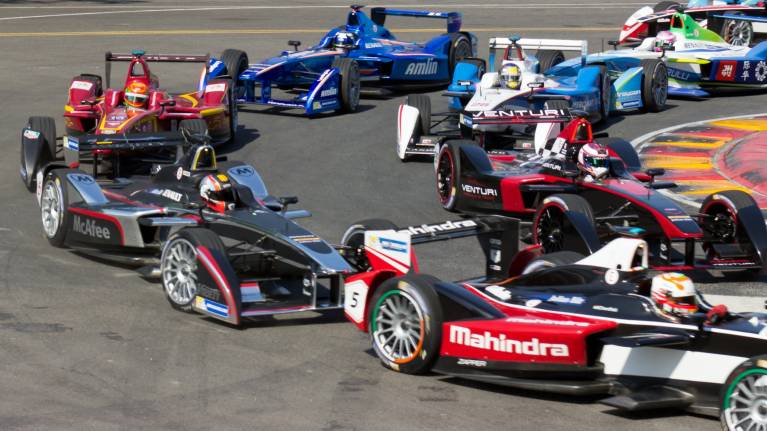
The Formula E Championship has revolutionised motorsports. Combining the speed, drama, and excitement of classic Formula 1 racing with state-of-the-art electric vehicle engineering, this competition proves that you don’t need petrol for a thrilling car race.
First launched in 2014, Formula E follows many of the same patterns as its combustion-engine predecessors. Like Formula 1 and Moto GP, the Formula E season comprises a series of Grand Prix events. In 2022, each of these events is contested by 22 drivers, representing 11 teams. Through a series of qualifying races, the drivers earn their spots on the starting grid, with the best-performing qualifier taking pole position for the main race. When this race is complete, the winner takes home a Grand Prix trophy and 25 championship points. Additional points are awarded for the second-to-tenth placed finishers, the polesitter, and the driver who records the fastest lap during the race. At the end of the season, the driver with the highest points total is named Formula E World Champion, and the team with most points across both its drivers wins the Team Championship.
Although much of this format is similar to the petrol-based motorsports championships, Formula E has also introduced some special features. Since the 5th season, each Grand Prix race has included power boosts known as “Attack Mode.” Reminiscent of high-speed video game racing, these 35kW motor boosts are triggered by drivers coming off the racing line to cross designated Attack Mode areas. All drivers must use the boosts by the end of the race, but they can choose when to do so, adding an exciting tactical dynamic to the contests.
More controversial among Formula E fans is the “Fanboost” feature, which converts fan votes into power boosts for the most popular drivers. Starting 3 days before the event and ending 15 minutes into the main race, the fan voting gives 5 drivers a small boost that they must use within a 5-second window in the latter half of the race. Although some viewers have been critical of this popularity contest, it continues to add intrigue and tension to a sport that already runs on drama as much as electricity.
The 8th season of Formula E is well underway now, and former Formula 1 driver Stoffel Vandoorne finds himself on the top of the drivers’ table, with Jean-Éric Vergne snapping at his heels. The next test for the competitors will be the Berlin E-Prix, which hosts Rounds 7 and 8 of the championship from 14-15 May. Each E-Prix event features the Allianz E-Village, a racing festival ground with big screens, delicious food and drink options, and immersive games. In Berlin, tickets for the E-Village are free for children and EUR €10 per day for adults. Grandstand seating is also available for great views of the circuit, starting at €25 per day for children and €49 for adults.
From Berlin, the drivers cross the globe and head for Indonesia, where the inaugural Jakarta E-Prix will be held on 4 June. With live music and all-day entertainment, tickets start at IDR 287,500 (USD $20) for the Ancol Festival area. Jakarta offers a number of different viewing options, and the most luxurious, the Jakarta Royal Suite, will set you back IDR 11,500,000 (USD $795).
The next stop on the Formula E world tour is the Big Apple, which will host the New York City E-Prix from 16-17 July. Allianz E-Village tickets are available free for children, while adults will need to pay USD $15. Grandstand seats start at $95, with wheelchair and companion seating also available.
Get your tickets now and be dazzled by the fastest electric racing cars in the world!