

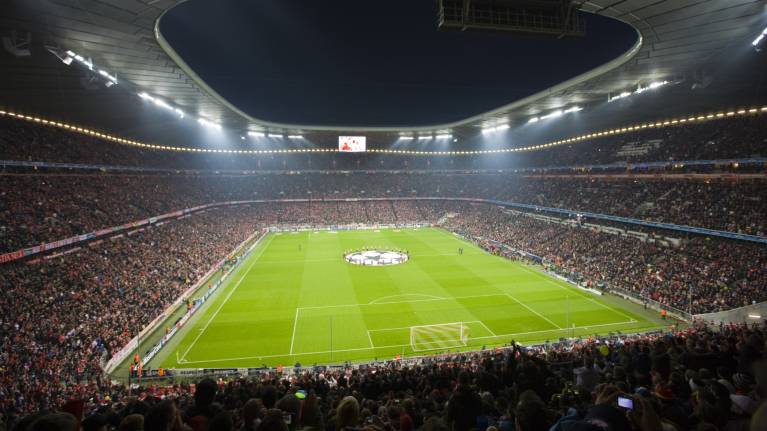
There’s something extra special about watching football live and in person, and that goes all the more so in the Champions League. Experiencing European nights under the lights is a dream for many a football fan, giving the game an extra buzz compared with the bread and butter of a Saturday afternoon kick-off, witnessing your team compete on the biggest stage alongside the world’s elite players and clubs.
Whether you and your team are regular Champions League attendees or European matches are a novelty for you, this guide is here to help you make the most of your experience with handy tips and useful advice. If you’ve not yet selected which match you’d like to attend or secured your tickets, check out our Buying Champions League Tickets Guide here.
- What to Bring and Wear
- When to Arrive
- Venue Parking & Transport
- Entry Gates
- Finding Your Seat
- Match Format and Schedule
- Additional Entertainment
- Crowds and Other Fans
- Taking Photographs and Videos
- Autographs
- Merchandise
- Food and Drink
- Toilets/Restrooms
- Leaving and Exiting the Venue
- Make the Most of It
What to Bring and Wear
More than anything else, the most important thing to remember to bring with you is your ticket! It’s rare to find physical tickets still in use these days, but if you do have one then make certain you have it with you when you set off. Provided you have your phone on hand, digital tickets make it easier to avoid any such issues, but it’s always a good idea to ensure your phone is fully charged and your tickets are accessible and loading before you travel to avoid any problems upon arrival.
As for clothing, much will depend on when and where the match you’re attending is taking place. The league phase runs from September to January, followed immediately by the knockout phase which typically concludes in late May or early June. Qualifying runs over the summer, so in theory you could be attending at virtually any point in the year. Likewise, with games taking place all over Europe, you might be attending a clash anywhere from the United Kingdom to Scandinavia to Spain, or even somewhere much more remote.
One thing that is consistent with Champions League scheduling is that matches take place in the evening. Football is of course an outdoor sport, so in many cases you’ll need to wrap up warm to protect yourself from the elements for an extended period. As with attending any such sporting event, it’s a good idea to consult the forecast ahead of time and bring a coat if it’ll be cold or wet. Even if your seat location is under cover, you’ll want protection if it’s raining during your trips to and from the ground. Koobit’s Destination tabs on each match page display both the current and average weather for the location for the time of year to help you plan accordingly.

Many fans naturally like to represent their team and wear their shirt to the match. You can find links to merchandise on Koobit’s team profile pages, accessible via the Champions League page. If you’re supporting the away team, only wear their shirt or colours if you’re sat in the away end, otherwise you could find yourself ejected from the ground for your own safety. If you’re travelling to a match in certain countries with an “ultra” culture – that is, extremely passionate hardcore fans – such as Italy, it may be advisable not to wear the visiting team’s kit or colours at all on matchday.
Prohibited items will vary between clubs and countries. Many might permit a small bag to be brought into the stadium subject to a search, but you’ll want to check the exact permissible dimensions in advance to ensure as smooth an entry as possible. It’s also worth bearing in mind that some larger cities have a reputation for pickpocketing, so caution is advisable when it comes to any bags or items on your person. Banners, flags, and tifos are usually permitted provided they do not feature any offensive content, but dimensions and specific rules will vary. When it comes to being allowed to bring your own food and water, this will also vary from club to club, so check in advance as to whether this is permitted and what restrictions may be in place. Commonly banned items wherever you go include weapons, laser pointers, air horns, and pyrotechnics, flares, and fireworks.
When to Arrive
Doors typically open around 90 minutes prior to kick-off, although this will vary – for some stadiums it may be 2 hours, at others just 1 hour. Arriving early is generally advisable, particularly if you’re an away fan as there may be delays in getting through the turnstiles due to extra safety and security regulations. It also allows you to soak up the pre-match atmosphere, buy any food, beverages, or merchandise at the ground, and watch the players warm up ahead of the game, not to mention find your seats if you’ve never been to the stadium before.

Venue Parking & Transport
Many stadiums will have some official and unofficial parking options in the vicinity, although for many Champions League matches – particularly if you’ve travelled to another country – driving to the game yourself is unlikely to be practical. Matchday congestion is typically an even bigger factor with midweek evening kick-offs as you might need to contend with rush hour traffic before the game, so bear that in mind if you are driving or taking a taxi/rideshare service.
Football stadiums tend to be fairly well-connected when it comes to public transport links such as trains, trams, and buses, but this can vary significantly between grounds and cities, so be sure to research ahead of time to make things as easy as possible come matchday. You can check Koobit’s Travel & Parking tabs for more detailed information for each ground. On the day itself, be sure to check your route planner for any road closures, strikes, or anything else that might impact your travel so you can change your route or departure time accordingly. As with traffic, public transport is likely to be busier than normal before kick-off as people head home from work, so factor that into your planning. Likewise, bear in mind that it may be after 22:00 or even midnight local time when you leave the ground, so make sure public transport services will still be running.
In some cases, shuttle buses or coaches may be organised for travelling fans by the clubs, UEFA, or supporters’ groups. Your experience in using such services may vary; football fans have occasionally reported arriving late to matches, an insufficient number of shuttles, or other such issues.
Entry Gates
Football stadiums typically have turnstiles running around their entire perimeter, so you’ll never be too far from an entrance. Usually, a gate or turnstile will be assigned on your ticket, so you should head to that one – at some grounds you may be able to enter via any gate/entrance, but at others it will need to be the one specified. Either way, it’ll usually be the one closest to your seats.

Stewards and security staff should be on hand to direct you, conduct bag searches, or check tickets (although this may be done electronically at the turnstile). Queues usually move fairly quickly but if you’re an away fan or attending the final (which is held at a neutral venue) there will often be extra delays in getting into the ground, so arriving early can help you bypass some of those issues.
Finding Your Seat
Your ticket should dictate the stand and section your seat can be found in, and potentially the tier as well if you’re attending a larger ground. You can find out more information on the types of seating areas available in our Buying Champions League Tickets Guide. Locating your seat is usually relatively straightforward, although it’s always a good idea to allow extra time for this if you’re unfamiliar with the stadium. Real Madrid’s Santiago Bernabeu has 6 tiers – you don’t want to be negotiating that with 2 minutes to go before kick-off if you’re not completely certain as to where you’re going. Keep an eye out for section names or numbers painted on the walls of the concourse, as well as the row numbers on the floor as you navigate the stairs in the stand. Stewards should be on hand to direct you around the concourse and stands to help make the process easier.
Taking your seat around 30 minutes prior to kick-off will allow you to watch the players warm up, although some fans may prefer to remain in relative warmth of the concourse until just 5 or 10 minutes prior to the game to finish drinks or food. In the United Kingdom, for example, it’s against the law to consume alcohol in sight of the pitch – local laws around Europe will differ. Space and legroom can vary significantly between grounds and even certain seating sections, so you might find yourself tightly packed in or with a bit of breathing room. You’re free to come and go from your seat as you please during the match but, if possible, be courteous to your fellow fans and only do so during breaks in play – you don’t want to block someone’s view of some key attacking action!

Match Format and Schedule
Football matches are played over 90 minutes, split into 2 halves of 45 minutes each with a 15-minute half-time break in between. Since the clock is not stopped during breaks in play, referees add time on to the end of each half to accommodate for any stoppages such as injuries or substitutions. This is often between 1 and 4 minutes provided no serious injuries have occurred, but the advent of VAR (video assistant referee) reviews in recent years have led to increases to the amount of time added on, so a match will often take closer to 2 hours to complete in total. Knockout tie second legs and the final may also require 30 minutes of extra time to be played if the sides cannot be separated by the final whistle, potentially followed by a penalty shoot-out, in which case proceedings may take closer to 3 hours.
Some clubs may put on half-time entertainment in some matches, such as legend appearances, fan penalty shoot-outs, or crossbar challenges. The Champions League final notably has pre-match entertainment ahead of kick-off, which has featured world-renowned artists such as Black Eyed Peas, Dua Lipa, and Camila Cabello over the years. In some cases, the concerts have led to delayed kick-offs.
Additional Entertainment
On the day of the final, UEFA will typically arrange fan zones elsewhere in the city for both sets of supporters featuring food and drinks for purchase, interactive entertainment, musical performances, and other activities such as face-painting. On regular matchdays, some clubs may have fan zones set up directly outside the ground.

Crowds and Other Fans
Football fans are often louder and more passionate than most other sports fans, and the Champions League brings together fan cultures from across the continent. In many European countries, such as Italy, France, and Turkey, a number of fanbases have adopted what is known as “ultra” culture – organised groups of ultra-passionate fans renowned for generating intimidating atmospheres for away teams, chanting, singing, and displays involving flares or banners. These supporters can add a great deal to the spectacle, but occasionally some members of these groups can escalate confrontations with away supporters to violence.
Ultra groups are usually known for occupying specific stands or sections, such as AC Milan’s Curva Sud in the Secondo Blu section at the San Siro, so you may want to research and avoid those areas to minimise any risks. However, if you’re there to cheer on the home team and you’re prepared to chant and sing and engage in the choreography throughout, you might make some incredible football memories.
Although it’s not uncommon to see individual fans interrupt a match to invade the pitch – and be swiftly ejected by stewards and security staff – crowd-wide pitch invasions are exceptionally rare at almost all levels of football, let alone its biggest club competition.

Ahead of kick-off, it can get very crowded on the concourse or in the areas immediately surrounding the turnstiles as large groups of fans congregate to enter the stadium. In some cases, away fans may be corralled by police or security staff into small enclosures before they’re allowed through the turnstiles, so please bear this in mind if you’re claustrophobic or bringing children with you.
If you need a breather from the crowd during the match, the concourse will usually be relatively empty aside from half-time and full-time. At half-time, many fans will head inside to get a drink, bite to eat, or use the facilities, so for that period you might find yourself with a bit more elbow room!
Taking Photographs and Videos
Professional cameras and recording equipment are generally prohibited, but you can feel free to take photos and videos throughout your time in the stadium using your mobile phone. Any recordings you make are only permitted for private or personal use, however – UEFA and their broadcasting partners are keen to enforce their rights, so live streaming to social media or uploading highlights are not permitted.

Autographs
Fans sitting in the rows very close to the pitch – especially if your seats are near the tunnel or the dugout – might get lucky in grabbing an autograph, selfie, or even a shirt from one of the players, such as when they emerge for the warm-up or at the conclusion of the match. If you’re determined to get an autograph or selfie you might also wish to try waiting for the players to arrive outside the stadium on the team bus or when they depart, as some players may stop to interact briefly with fans. You’ll need to be at the ground at least an hour before kick-off to have a chance ahead of the game, and after the match you may also need to wait a reasonable length of time for the team to emerge. It’s worth keeping in mind that not all players will stop to greet fans – especially if it’s after the match and they’ve lost – and that they’ll generally prioritise children.
If you’re going for an autograph, remember to bring a marker pen and something for them to sign! And, of course, be polite and respectful.
Merchandise
Most clubs will have their club shops open before kick-off on matchdays so fans can buy shirts, scarves, and hats before the game. There will often be vendors selling merch – which might be unofficial – outside of the stadium too. If you’re a more casual fan, purchasing a “half-and-half" scarf will single you out as a tourist, as they’re not typically bought by regular match-going fans.
If you want to buy a shirt online in advance so that you can wear it to the match – and potentially find better prices – you can find official merchandise on the club’s official website or at Fanatics.

Food and Drink
The food and drink offerings available at each stadium, their pricing, and their quality will be very dependent on where you go, but you can usually expect a mix of stadium classics such as burgers and fries and some local cuisine. If you’re seeking vegetarian or vegan food or have other dietary requirements, your mileage may vary. Queues for concessions can be lengthy, so if you do plan on eating at the ground you may want to arrive a little earlier; it’s common to see fans returning to the concourse a few minutes before the end of the first half to get a jump on the half-time queues as well. Many grounds will also have food trucks or other dining options close by, so you can reliably find something to eat before or after a match too if you’d prefer not to eat at the stadium itself. If you have a hospitality ticket, your package will likely include a pre-match meal in one of the stadium’s in-house restaurants.
In some cases, you may be able to bring in food from outside – it's not uncommon to see fans unwrapping their bocadillo sandwiches at half-time in the Santiago Bernabeu – but this will depend on the ground. Likewise, some may allow you to bring in a 500 ml bottle of water, provided you remove the cap beforehand – check what is and isn’t allowed with the club before you go.
When it comes to alcohol, it largely depends on local laws. For example, no alcohol may be served at sporting events in Spain, while in English football clubs can sell alcohol in their stadiums but it can’t be consumed within sight of the pitch. Beer is a key part of the German football experience and relatively affordable; according to the Bundesliga’s official website, the average price of a 0.5 litre beer is just under €5.20, while the average cost of a bratwurst comes in at €3.80.
Most venues will still take cash, but some modern stadiums like Tottenham Hotspur’s are cashless, so it’s always a good idea to have a card with you just in case.

Toilets/Restrooms
Toilets are usually plentiful at most football stadiums, so you’ll rarely be far from the facilities. Cleanliness and the quality of those facilities can vary significantly from ground to ground, however. At some older grounds, they can leave a lot to be desired – the San Siro’s “hole in the ground” toilets are particularly notorious among fans – but this is by no means the case everywhere. If you want to use the toilets at their most clean and to avoid the biggest queues, it’s recommended you go before kick-off rather than at half-time or full-time when hundreds or thousands of fans may have passed through.
Leaving and Exiting the Venue
Leaving any football match at a larger stadium – and most Champions League teams occupy larger stadiums – can be busy and hectic, although crowds do tend to move quickly and it usually only takes a few minutes for grounds to empty.
It can be slow to get away from the stadium due to congestion or the influx of fans on public transport. As such, it’s not uncommon to see fans leaving 5 or 10 minutes early – particularly if the match is in the league phase or if it’s a knockout tie that is effectively settled – to get ahead of the crowds. Some football purists balk at the idea of leaving before the final whistle, but a few minutes can sometimes make an enormous difference in terms of the time you get home, so it’s up to you – just be prepared in case you miss a dramatic last-gasp comeback!

For safety reasons, away fans are usually kept behind in the stadium for half an hour or so after the final whistle, so remember to factor that into your travel plans. Likewise, knockout tie second legs could go to extra time or penalties, so these matches could run on for almost an hour longer than normal.
It could be after 22:00 or even past midnight local time when the game finishes, so it’s courteous to keep noise to a minimum especially if the stadium is in a residential area, and if you’re using public transport then make sure the local services are still running.
Make the Most of It
Whether you’re a regular Champions League attendee, a casual fan, or ticking an experience off your bucket list, the most important thing is to enjoy your matchday experience. You might not be able to control what happens on the pitch, but with a little research and preparation you can ensure as smooth an experience as possible. Unexpected delays and minor inconveniences are also part and parcel of attending any live event, so embrace them as part of the experience and above all else have fun!