

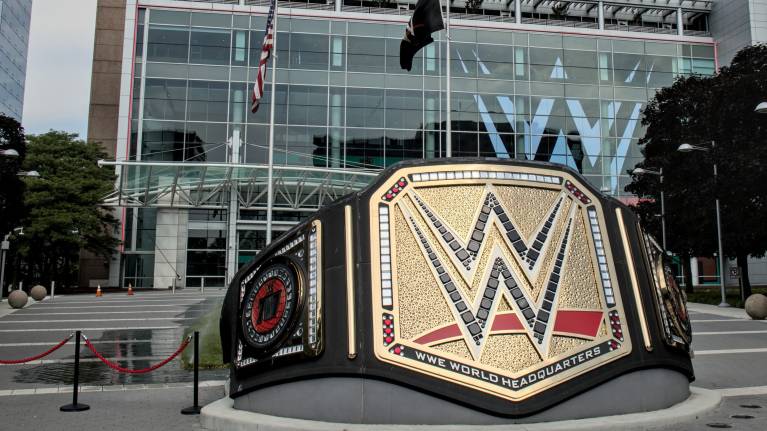
World Wrestling Entertainment (WWE) is an American sports entertainment company and professional wrestling promotion. With a presence across the globe, and TV shows available in more than 30 languages, it is the largest and most popular wrestling organization in the world.
Long considered the pinnacle of professional wrestling, WWE is a global phenomenon. A powerhouse in the world of sport and entertainment, the organization has, over the years, been home to household names like Dwayne “The Rock” Johnson, Stone Cold Steve Austin, Hulk Hogan, John Cena, Trish Stratus, and Roman Reigns. With wrestling at its core, and supported by a huge roster of larger-than-life stars, WWE continues to captivate audiences of all ages with its unique blend of combat sport, acrobatics, and live theater.
- WWE History
- WWE Event Format
- WWE Key Rules
- Famous WWE Superstars
- WWE Terms Glossary
- Attending a WWE Event
WWE History
WWE was founded in 1953 as the Capitol Wrestling Corporation and, led by the McMahon family, quickly took the American wrestling scene by storm. After 2 formative decades of steady growth, the promotion, then known as WWF, exploded into life in the 1980s. As the likes of Hulk Hogan and “Macho Man” Randy Savage gained the company mainstream attention with their exploits in the ring, behind the scenes Vince McMahon turned US wrestling’s traditional "territory" system on its head by striking national TV deals and acquiring blue-chip talent from rival promotions.
Arguably WWE’s greatest challenge occurred in the 1990s when it came up against billionaire Ted Turner’s new wrestling company, WCW, in what became known as the “Monday Night Wars” (Monday nights were when WWE’s flagship Raw show and the WCW equivalent Nitro went head-to-head on national television). By the turn of the Millennium, thanks to megastars like The Rock, Triple H, Stone Cold Steve Austin, and The Undertaker, WWE had prevailed and McMahon purchased WCW for around $7 million – solidifying WWE’s position as the biggest pro-wrestling organization in the world.

Largely unchallenged by competition throughout the 2000s, WWE has become synonymous with the sport of professional wrestling. While stars like John Cena, Randy Orton, Roman Reigns, and Becky Lynch awed crowds in the ring, the company grew into a global force and now boasts offices in Connecticut, New York, Los Angeles, Mexico City, Mumbai, Shanghai, Singapore, Dubai, and Munich. During this time, WWE has branched out into other fields, including film, American football, video games, and more. However, the focus remains on the action in the ring and its core wrestling brands Raw, SmackDown, and NXT.
WWE Event Format
WWE events are generally organized around a "card" of wrestling matches. Between matches, the company keeps fans entertained with backstage interviews, interactive segments, and surprise appearances. These various elements combine to create full-length shows, which often air live on TV.
Event Duration
WWE events generally last anywhere between 2 – 4 hours. House shows usually last 2.5 hours, weekly TV shows around 2 hours, while Premium Live Events are often just over 3 hours in length. WrestleMania, WWE’s biggest show, currently takes place over 2 nights, with shows in excess of 3 hours on each night.
Matches, the lifeblood of any WWE event, can be between 5–60 minutes long. Most matches are less than 30 minutes in length, but main events at major shows can be longer. A WWE show will feature between 5–10 matches, depending on the event.
WWE house shows are usually the only type of event that features a short intermission. TV shows and PLEs do not have an organized break, but will have plenty of gaps between matches for commercials or backstage segments, which can be used for visits to the bathroom or trips to the concessions stand.
Take a closer look at the 2024/25 WWE schedule here.

Winning a WWE match
As is the case across the entire world of professional wrestling, WWE matches – despite the very real blood, pain, and injury that can occur within them – are not legitimate sporting contests, but staged, entertainment-based performances with scripted storylines and choreographed finishes. Taking place one after another, these matches see 2 or more wrestlers pit their strength (and their wits) against each other in an attempt to achieve victory by pinning their opponent to the ground, or making them submit. On rare occasions, other methods of victory might be in place. For instance, a cage match may be winnable by escaping the cage, or a ladder match often requires wrestlers to retrieve a title, or item, hanging above the ring. For the benefit of the crowd, a ring announcer will announce each match type before it begins.
WWE Titles
Ultimately, WWE wrestlers want to win matches, rise to the top of the organization, and prove their worth by getting their hands on a championship or title belt. There is a loose hierarchy for these titles in WWE, with the company’s biggest stars vying for the top belts. Major title matches will usually take place in main events towards the end of a show, while less prestigious championships will be defended towards the beginning or middle of the evening.
WWE’s current title belts, in rough hierarchy order within each show, are as follows:
Monday Night Raw
- World Heavyweight Championship
- Women’s World Championship
- Intercontinental Championship
- World Tag Team Championship
Friday Night SmackDown
- Undisputed WWE Championship
- WWE Women’s Championship
- United States Championship
- WWE Tag Team Championship
- WWE Women's Tag Team Championship
NXT
- NXT Championship
- NXT Women's Championship
- NXT North American Championship
- NXT Women’s North American Championship
- NXT Tag Team Championship

WWE Key Rules
The following are phrases related to key rules employed in WWE matches:
- Pinfall · A method of winning a match, achieved by pinning an opponent’s shoulders to the mat for a 3-count
- Submission · Another method of winning, this time by applying a hold that forces an opponent to submit, or pass out
- Countout · When a wrestler stays outside the confines of the ring for too long (usually for the referee’s 10-second count) and is therefore disqualified
- Disqualification · When a wrestler is deemed to have broken any number of key rules (e.g. using a foreign object to attack an opponent, refusing to break a hold within the referee’s count), and is therefore eliminated from the match
- Draw · A match that ends in a tie, usually by double disqualification or a double pin
Famous WWE Superstars
WWE has built its history on showcasing the best wrestling talent on the planet. Here is a list of some of the company’s top current stars:
- Cody Rhodes · Son of the legendary Dusty Rhodes and face of the company
- Roman Reigns · Previously held the Undisputed WWE championship for over 720 days
- CM Punk · Fan favorite in his second run with the company
- Bianca Belair · Women’s Triple Crown winner and 2-time Women’s Champion
- Rhea Ripley · Former champion and popular rising star

WWE Terms Glossary
The following are key terms you are likely to come across when watching a live WWE event:
- Babyface · The good guy or hero
- Heel · Bad guy or villain
- Card · The slate of matches for an event
- House show · A show not filmed for TV
- Dark match · An untelevised match that takes place before or after a televised show
- Gimmick · A wrestler’s fictional character traits or personality
- Heat · When a wrestler is booed by a crowd or draws a similar negative reaction
- Pop · Positive crowd reaction
- Over · A wrestler is over if they draw a strong reaction from the crowd, whether that be positive for a face, or negative for a heel
- Turn · When a wrestler switches from face to heel, or vice-versa
- Stable · A group or faction of wrestlers who work together
- Finisher · A wrestler’s signature move
- PLE · Acronym for Premium Live Event – formerly known as pay-per-views, these are WWE’s biggest shows
- WWE Universe · Name used for WWE's fanbase
- Number one contender · A wrestler next in line for a title shot
- Superstar · Alternative name used by WWE for its wrestlers (for many years WWE wrestlers were exclusively known as "superstars")
Attending a WWE Event
If you’re interested in attending a WWE event, take a look at the following links: