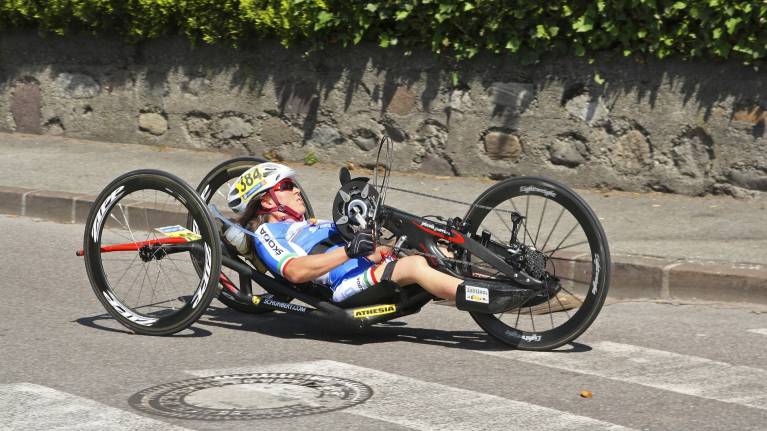
Para-cycling (or paracycling) is the sport of cycling adapted for cyclists with various disabilities and impairments. It is governed by cycling's global governing body, the Union Cycliste Internationale (UCI). The sport consists of different events under the disciplines of road and track cycling.
Para-cycling has its origins in the 1980s when visually impaired riders competed on a tandem bicycle with a sighted partner. The sport was inaugurated in the Summer Paralympic Games in the mid-80s, where it consisted of only road races for riders with cerebral palsy. Over the next 4 installments of the Paralympic Games, further events were added. In the 1996 Games in Atlanta, track cycling was included as well as races for a variety of disabilities in various functional categories. Handcycling was included in the 2000 Sydney Paralympics as an exhibition event. The UCI Track and Road Worlds Championships were inaugurated in 1994.
Format & Scoring
Para-cycling events consist of the 3 road races and 5 track events:
- Road - road race (men and women); individual time trial (men and women); handcycling team relay (men and women, mixed event)
- Track - tandem sprint (men and women); team sprint (men and women, mixed event); 500 m time trial (men and women) or 1 kilometre time trial (men and women); individual pursuit (men and women); scratch race (men and women)
Classification of riders consists of 3 broad groups: visual impairment, cerebral palsy, and physical impairment. These are subdivided into 14 functional categories for men and women. Riders are placed in the appropriate category according to their functional ability.
- B: blind (tandem) B1-2
- C: cycle C1-5
- H: handbike H1-5
- T: tricycle T1-2