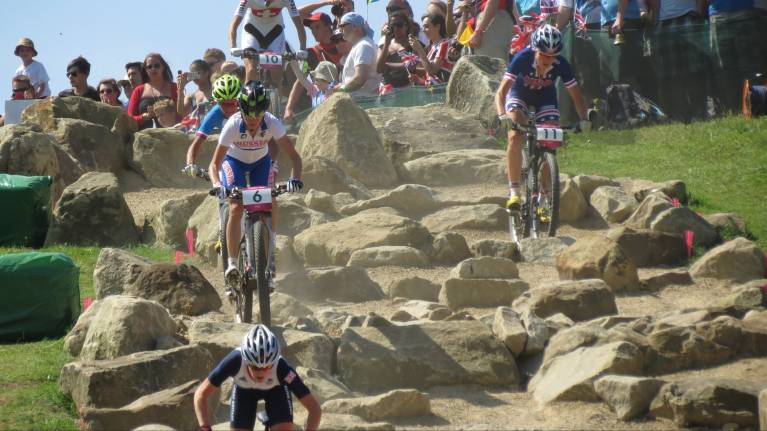
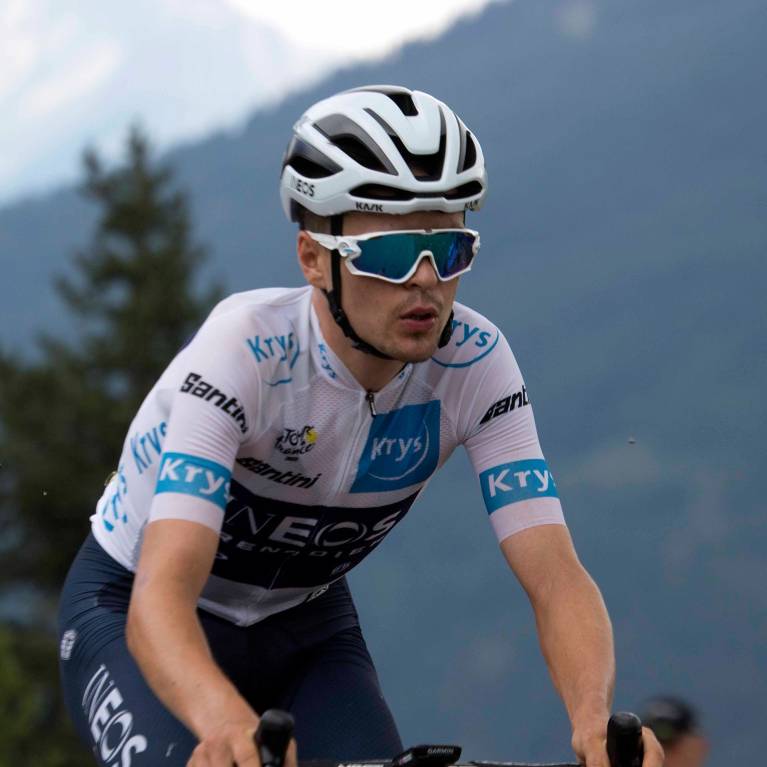
Mountain bike - shortened MTB - is the competitive racing discipline of mountain biking held on off-road terrain and is a true test of strength, endurance, and quick thinking.
Mountain bike racing began when the first mountain bikes were created with early competitors - calling themselves "klunkers" - descending courses on heavily modified beach cruiser bikes (as predecessors of modern mountain bikes) among the mountains in California. The oldest organised cross-country (XC) racing event is believed to have taken place around Aspen in Colorado in 1978.
The Union Cycliste Internationale (UCI) recognised the discipline in 1990 when it organised the World Championships in Colorado but the first UCI Mountain Bike World Cup series took place 2 years earlier. In 1996, cross-country mountain biking events were added to the Olympic Games.
Format & Scoring
There are numerous types of mountain bike racing:
- Cross-Country (XC) - held on a varied terrain circuit around 6-8 km and is always a massed-start race. Professional level races are longer in distance (around 50 km). Under this, there is Cross-Country Olympic (XCO)
- Short Track Cross-Country (STXC) - a very short XC style event of about 800 m in length but generally about 1 minute 30 seconds in winning time. A short, sharp exciting event to watch and participate in. It is also called Cross-country eliminator
- Downhill (DH) - a time trial event. Riders start at intervals that can vary from 30 seconds to 3 minutes and the rider with the lowest time wins. These races are held on steep, downhill terrain, resulting in higher speed than in cross-country racing. The terrain is also significantly rougher than in cross-country racing
- Super D (SD) - a blend of cross-country and downhill. Most of the race is downhill, on trails similar to the downhill segment of a cross-country race. There are also short uphill sections so most riders use cross-country or trail bikes. Depending on the trail and race venue, the start may either be seeded (riders start in short intervals), or mass start (riders run to their bikes, timing is started when the riders start running)
- Freeride (FR) - a competition of skill and style. Courses contain varying cliffs, drops, obstacles, and ramps. There are usually a large number of ways in which to complete the course, and scoring is dependent on the competitor's choice of routes, the fluidity of riding and tricks performed (style), and sometimes also the time in which the course is completed
- Dual Slalom (DS)/Dual (DL) - DS pits 2 riders against each other on 2 identical man-made tracks side by side with the same jumps and berms, with a rider on each track, and the first across the line wins. The contest has a knock-out format. Dual (DL) events are similar, only 2 riders share the same course/track
- Four cross (4X) - also known as mountain cross or bikercross and inspired by the dual format and BMX racing, this event pits 4 riders on the same course from starting gates to finish. There can only be one winner per event, so the races can quickly eliminate riders making the progression faster for a day's events. In 4X, riders are each given a run down the course which is timed and the top 50% of the field then progress to the elimination rounds. In mountain cross, riders are given 3 heats against 3 other riders, and points are allocated for the position in each heat
- Cross-Country eliminator (XCE)
- Marathon (XCM) - riders often have to cover more than 80 km in one race on mountainous terrain. The distances usually vary from 60 km to 100 km
- Enduro - the downhills are timed, and the uphills are not. Riders are timed in stages that are primarily downhill, with neutral "transfer" stages in between. The transfer stages usually must be completed within a time limit, but are not part of the accumulated time
- Stage Races (XTS) - consist of several races - "stages" - ridden consecutively, usually over a period of several days. A stage is usually similar in length and structure to a Marathon mountain bike race
- Bike trials - negotiation of man-made and natural obstacles where setting a foot down constitutes a penalty
- Dirt jumping (DJ) - a competition of skill that involves the rider jumping off mounds of dirt to perform the best tricks with the best style. It differs to freeriding in that the jumps are usually much larger and designed to lift the rider higher into the air
- Mountain bike orienteering (MTB-O or MTBO) - navigation is done along trails and tracks. The major focus becomes route choice while navigating at bike speed. Special equipment used is a map holder attached to the handlebar of the bike
- 24-hour mountain bike races - endurance mountain bike racing where solo competitors or teams race for a period of 24 hours and standings are based on who has ridden the furthest distance in that time (typically, the most number of laps around a loop)